drives · current solution
Push
Why do so many products fail in the market? Usually, there is no clear understanding of what customers actually need. This case study of Mantrafant shows how it can be done differently. By consistently applying the Jobs to Be Done (JTBD) method together with Oberwasser Consulting, the company was able to increase its sales fivefold.

It wasn’t the offer that blocked the purchase, but the gruelling burden of deciding. (Post-mortem; the brand was discontinued in 2026.)
Scroll through Lea’s path from slipping to a non-slip mat.
None of this appeared in a questionnaire. It sits between the lines of an in-depth interview. What are your buyers saying between the lines?
On the mat, she couldn’t find any grip – precisely when her practice became intense.
The purchase didn’t fail because of the product range, but because of the burden of deciding – endless research before a single mat was bought.
A trusted recommendation ended the research. Trust replaced her own uncertainty and made the purchase possible in the first place.
→ The decision happened with the teacher – not in the product range, not in the star ratings. Are you where things really tip for your customers?
Click a force. Green = gain · Red = problem. Columns: current vs. new solution. Rows: drives vs. holds back.
→ Do you know which one tips the balance for your buyers?
Lea’s buying decision had two layers: the functional one was on the spec sheet – the emotional one tipped the balance. Each was tied to how she measured progress.
Visible · printed on the packaging
Having a secure grip in yoga and choosing a mat she won’t regret.
Seeing herself as a thoughtful consumer who doesn’t rush into the wrong choice.
Even a beautiful mat was rejected as soon as it lacked grip. Anyone marketing yoga mats on design and sustainability missed the hard buying criterion.
Five mats in the basket, no purchase: it wasn’t too little choice that blocked her, but too much. A pre-selected recommendation would have broken the deadlock.
A trusted voice with a link ended the research in seconds. This recommendation channel was the strongest – and the cheapest.
An experienced practitioner was emotionally attached to her mat – pride, memory, identity. But she only bought once the grip had been proven in a shop. (Post-mortem; the brand was discontinued in 2026.)
Scroll through Marie’s path from her slipping old mat to the premium mat she is attached to.
The emotional attachment was real – but it only came after the proof of grip. Can you tell in which order your customers really decide?
Her old mat lost its grip. ‘Good enough’ became noticeably unfit for purpose.
The lack of grip took the joy out of her practice – the very reason she did yoga at all.
‘And there’s no grip, and I slip, and I don’t enjoy yoga.’
A friend recommended the premium mat, Marie tested it in a shop – and was convinced by the grip. The proof replaced her doubts about buying online.
An event with a fixed date turned putting it off into immediate action: the unfit travel mat had to be replaced.
The product became part of her identity – the mat carries the memory of a time she loved.
→ She only bought after the physical proof of grip in the shop – exactly what was missing online. Do you prove the buying criterion before your customers start to doubt?
Click a force. Green = gain · Red = problem. Columns: current vs. new solution. Rows: drives vs. holds back.
→ The emotional attachment only came after the proof of grip. Do you know the order in which your buyers build trust?
Marie’s buying decision had three layers: the functional one was grip – the emotional and social ones tipped the balance. Each was tied to how she measured progress.
Visible · printed on the packaging
Having a reliable grip and finding the one mat that belongs to her.
Feeling completely at ease with her mat as a beautiful, empowering ritual object.
Visibly living and showing her yoga practice as part of her identity.
Looks, colour and identity mattered a lot – but only once the grip had been proven. Beauty confirmed the grip, it never replaced it.
What convinced her was the physical ‘I stick’ experience. Anyone selling online had to replace exactly this proof – otherwise the doubt remained.
The strongest retention was emotional: pride, identity. A spec sheet can’t create that.
Lea and Marie bought for different reasons – yet both stumbled over the same question. From 4 interviews, 2 segments, one bottleneck and five levers emerged.
From 4 interviews, 2 segments emerged bottom-up. However different their stories were – the question that decided the purchase was the same.
Anyone who overlooks the pattern optimises for looks and price and misses the point – and loses both segments to the quick Amazon mat.
Having a secure grip – and choosing a mat she won’t regret.
Having a reliable grip – on a mat that is beautiful too and feels like hers.
→ Both segments stumbled over the same question. Across which segment boundaries does your market share a bottleneck?
Grip was the hard knock-out criterion across segments. Beautiful mats were rejected as soon as they slipped – looks and story confirmed the grip, they never replaced it.
A recommendation from a trusted person – teacher, friend – or a test of her own ended the gruelling research. Anonymous specifications and star ratings didn’t.
From the customer’s point of view, the strongest competitor was rarely another premium mat:
‘I’m not really under any pressure there at the moment.’ The old mat stayed ‘good enough’.
keptAvailable immediately, lots of reviews – the default choice.
keptGrip felt first-hand rather than taken on trust online – via a peer recommendation.
chosenThe losses were to ‘good enough’ and the quick Amazon mat – not to other premium brands.
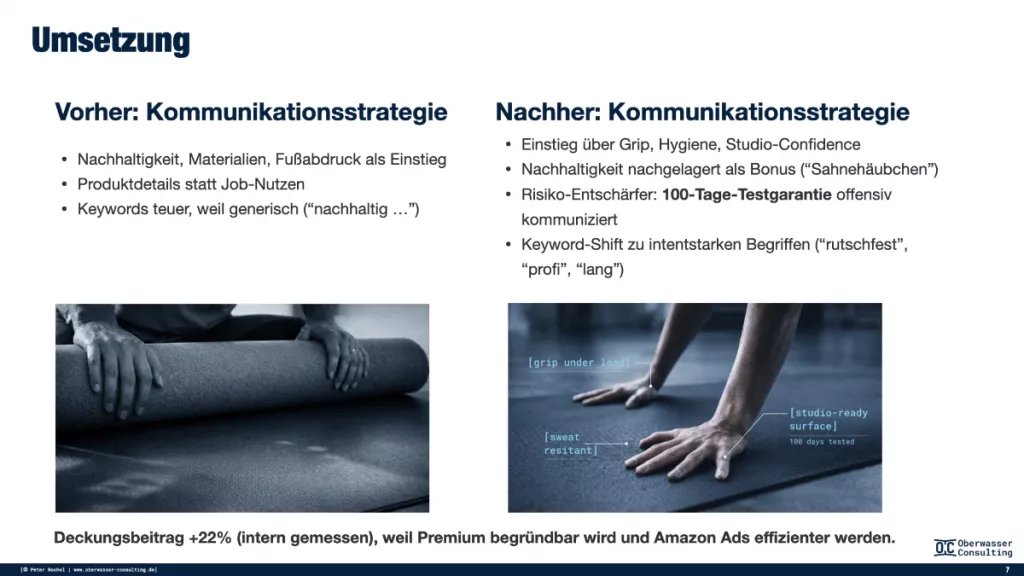
Buyers couldn’t answer the one question that decided the purchase – ‘Will the mat slip?’ – online, before buying. Instead, Mantrafant put its sustainability promise centre stage – a signal that didn’t drive any purchases. The actual job was not at the centre of the positioning.
Five concrete levers could be derived from the bottleneck – all without more advertising budget, purely through higher conversion and the recommendation channel.
Three of them were non-negotiable: proof of grip, guarantee, recommendation channel.
Demo video showing sweaty, long sessions plus a teacher testimonial with a verbatim statement on grip.
Risk down to zero instead of a specification argument – compensates for the missing in-store test.
Pilot with 15–25 teachers, trackable links, samples sent out – the trusted channel as a system rather than chance.
One pre-selected, recommended option instead of long comparisons of ranges and specifications.
Grip at the centre of product and message; sustainability at most as an added benefit once the grip has been proven.
Conventional marketing measures the wrong things – clicks, reach, target groups. Jobs to be Done measures why people really buy, and turns everything that follows – product development, marketing, sales – the right way up. In a few days, you’ll have this compass for your own business.
We only take on a few sprints per quarter.
Mantrafant (in German) produced sustainable, high-quality yoga mats. Despite enthusiastic customer reviews, the company stagnated. Marketing campaigns had no effect, revenue stagnated, growth failed to materialise. The Mantrafant team realised: something was missing – but what exactly?
Mantrafant originally believed that sustainability was its customers’ most important reason to buy. But intensive marketing around ecological benefits brought hardly any sales. The team suspected: the customers’ true buying motives lay hidden deeper down.
Sustainability is not the purchase trigger. Sustainability is the justification that becomes the story after the purchase. Anyone who turns the message round and puts sustainability at the top as the main selling point talks past customers’ real buying motives – and fails systematically.

Together with Oberwasser Consulting, Mantrafant began with structured JTBD interviews. These revealed surprising insights: not sustainability, but comfort, hygiene and safety were the decisive buying motives. Customers wanted yoga mats that were, above all, comfortable and hygienic, so that they could train without worrying.
Stefan Hück (Mantrafant’s founder) told the whole story in conversation with Peter Rochel – including the interview mechanics that made the real buying motives visible: ‘Nobody buys because of sustainability – how Mantrafant sold 5x more yoga mats’ on YouTube (in German).
Based on the JTBD findings, Mantrafant’s entire communication was changed: new advertising messages focused on hygiene, comfort and a better yoga experience. Product images and landing pages were optimised with the customer in mind. The effect was immediately noticeable.
Impulse magazine also reported in detail on Mantrafant’s success with the JTBD method. Read the full article here (in German).
More than 700 consulting projects and three documented JTBD studies on sustainable products – B2C consumer goods (yoga mats), energy technology/sector coupling and B2B mid-sized companies – consistently show the same pattern. Sustainability is not the purchase trigger. What really drives buying decisions:
Not values but effects are the language people buy in. Anyone who communicates sustainability without a numerical anchor burns attention.
In B2B mid-sized companies, it blocks entire communication strategies for years. Anyone who communicates as sustainable without substance they can prove burns trust – and buyers react with suspicion instead of enthusiasm.
The neighbour with the actual photovoltaic system. Advertising is not the primary trigger – the peer with real figures is. Marketing budgets without peer amplifiers come to nothing.
Anyone who communicates without substance they can prove loses. Anyone who builds substance AND then makes it visible wins. Marketing-first fails systematically in sustainable categories.
As soon as sustainability is negotiated as a price premium, it fails. Anyone who sidesteps the price-premium argument and delivers sustainability at no extra cost wins.
Anyone who makes this pattern visible reverses the force of inertia: waiting becomes expensive, acting pays off. In sustainable categories, promises about the future work less well than keeping the loss in view.
This is exactly what Mantrafant discovered in its own JTBD interviews – comfort, hygiene, safety and room aesthetics beat sustainability. The yoga mat isn’t bought for the planet, but for the training session. Sustainability is what becomes self-reassurance after the purchase.
Mantrafant sold mainly through Amazon. Four concrete ways to apply this to any Amazon listing for sustainable products:
Anyone who reconstructs the job properly realises: the competition isn’t the other sustainable yoga mat. The competition is the banana, the borrowed mat at the studio, skipping the session. Once you’ve understood the job, you immediately have a list of new listing optimisations.
Would you like to understand real customer needs as Mantrafant did back then, and grow your business sustainably? Oberwasser Consulting supports you with proven JTBD workshops and individual consulting to understand your target group’s buying motives in depth and use them in a targeted way.
Download the case study as a PDF
In German: diagnosis, strategy pivot, measurable results. By email – double opt-in; the emails are in German too.
Free. No spam. Double opt-in.
Three documented JTBD studies on sustainable products consistently show: sustainability is not the purchase trigger, but the justification that becomes the story after the purchase. Customers buy because of concrete effects (comfort, saving money, hygiene, safety). Sustainability reinforces the decision, but is rarely the primary driver.
In the Mantrafant study, they were comfort, hygiene, safety and room aesthetics. Across other JTBD studies in sustainable categories, we consistently see six patterns: concrete figures instead of climate arguments, avoiding the fear of greenwashing, peer validation instead of advertising, ‘do it first, then talk about it’ as a reputation line, cost-neutral door-openers instead of price-premium arguments, regret over lost time instead of promises about the future.
Write product titles by job rather than by material, structure the bullet order by job priority (top job first, sustainability as a bonus), use images as proof for customers’ most important concerns (e.g. slip resistance, hygiene), design A+ content as proof of the job rather than as a manifesto.
For Mantrafant’s strategy correction, a few structured JTBD interviews were enough. What matters is not the quantity but the interview technique: reconstructing the script rather than polling opinions.
The Wheel of Progress Canvas is the JTBD analysis tool developed by Eckhart Böhme and Peter Rochel. From interview material, it brings together the central components of a customer job: events (triggers), forces (push/pull/anxiety/habit), needs, outcomes. At Mantrafant, the canvas made the real buying motives visible and led directly to the strategy correction.
At Mantrafant, the first measurable results became visible within a few weeks of the strategy change (marketing messages, listing optimisations, reallocation of advertising). The prerequisite: consistently translating the JTBD insights to the operational level. JTBD insights that sit in a drawer deliver nothing – implementation is what counts.
The decision template is the format in which steering committees say ‘yes’: options, trade-offs, measurement signals – on one page. Tested in more than 700 projects.
Download the decision template (in German)
4-page PDF in German – ready to fill in, free by email.
More cases: All case studies & interview analyses at a glance →
11. August 2026
The three types of innovation – sustaining, efficiency and market-creating – with examples, the fields exploit and explore, and the link to Jobs to be Done.
[...]
Read postIn this JTBD podcast shot, Peter Rochel explains what hypothesis-driven working is. In just under 6 minutes, Peter shows you what to look out for and shares valuable tips and tricks that will save you time, nerves and money.
[...]
Read postI+U podcast shot. In four minutes, Peter Rochel nails down what the solutions element means in the JTBD context and how solutions help you identify the best market for your product.
[...]
Read postI+U podcast shot. In three minutes, Peter Rochel gets to the heart of what defines the JTBD element “limiting context”.
[...]
Read postForces are one of three central elements of a Job to be Done and of The Wheel of Progress JTBD Canvas – alongside events and the limiting context. They are the emotionally charged drivers of – or brakes on – progress and change.
[...]
Read postI+U podcast shot. In six minutes, Peter Rochel explains why events are so important in a JTBD context – which events there are and how to use them.
[...]
Read postLearn how the Jobs to Be Done method and strategic business development shape the purchase decision for coffee pot spare parts. Discover innovative ways to strengthen sustainability and customer loyalty.
[...]
Read postJTBD Meetup in Frankfurt am Main, 6 February Thursday, 6 February 202018:45 to 20:45 Knowing the jobs to be done of your target group is important input when it comes to developing new products and product strategies. At this meetup, Eckhart Böhme will introduce you to the new The Wheel of Progress canvas (wheelofprogress.com). Working as a […]
[...]
Read post8. April 2025
JTBD interviews are supposed to visualise customer needs – but often nothing happens afterwards. Find out why the transfer fails and how you can do better in this podcast episode with Jan Milz. We show you how to use jobs-to-be-done research strategically and systematically transfer results into products, communication and innovation.
[...]
Read post8. October 2023
Discover the channel phase model developed by Peter Rochel to get the most out of your jobs-to-be-done research and optimally align your product or business model with customer needs.
[...]
Read post3. October 2023
Innovation Strategies for Competitive Advantage: JTBD Workshop
At a time when companies need to constantly reinvent themselves to remain competitive, Oberwasser Consulting and UTXO Solutions jointly launch their latest live online workshop: “Mastering Jobs To Be Done (JTBD) Innovation Framework”.
This training is aimed at decision-makers, product managers, developers and other specialists in product development. It offers efficient methods and frameworks for all those who want to secure their company’s innovative edge. For the first time since 2020, Oberwasser Consulting’s complete JTBD Innovation Framework is again available in a format accessible to all and not just as an exclusive in-house offering
[...]
Read postAre you looking for an effective method for customer research and innovation management? Then the Wheel of Progress is just right for you. In our latest podcast episode, Katharina Weigert and Peter Rochel talk about the versatile applications of this revolutionary framework.
[...]
Read post30. September 2023
Innovation & Strategic Development: A Comprehensive Guide to Corporate Success -Delve into the myriad facets of innovation and strategic development, exploring their indispensable roles in achieving sustainable corporate success. Gain insights from the experts at Oberwasser Consulting and learn how to integrate innovative strategies to stay ahead in today’s dynamic market.
[...]
Read post25. March 2023
The Jobs-to-Be-Done (JTBD) method is a powerful tool to drive innovation and transformation in organisations. A crucial success factor for JTBD projects is well-conducted interviews with the right candidates. In this article we will give you tips and tricks on how to find the right interview candidates for your JTBD interviews and how to prepare them optimally.
[...]
Read post15. March 2023
🎧JTBD Deep Dive: From Research and Product Development🎧Dive into the world of product development and research with Jobs to Be Done! Learn about the challenges and misunderstood tools in this field. Get valuable insights and take your products to the next level. Listen to the podcast now!👂💻💡
[...]
Read post3. March 2023
In the contemporary economic landscape, a fierce competition prevails, and it has become imperative for businesses to continuously enhance their offerings, be it products, services or even their business models, to stay relevant and competitive. To create a prosperous product or service, it’s crucial to comprehend the demands and prerequisites of our patrons. Achieving a deep understanding of our customers’ needs will allow us to cater to their requirements effectively and build long-lasting relationships with them. By taking the time to study their wants and pain points, we can develop solutions that are not only efficient but also exceed their expectations. Ultimately, this approach can lead to increased customer satisfaction, loyalty, and business growth. A proficient approach to fulfilling these necessities is by implementing the Jobs-to-be-Done (JTBD) methodology. This piece of writing aims to elucidate the concept of the JTBD methodology and provide guidance on its effective implementation.
[...]
Read post26. May 2021
Podcast Short Episode (German language)- What is a Job to Be Done? Peter Rochel explains in 4 minutes what a JTBD is, how to describe it, which elements belong to it and why you need it.
[...]
Read post15. June 2020
Great idea! (we don’t do either) Wheel of Progress, Jobs to Be Done, agile working, Design Thinking , Business Model Canvas and, and and… are certainly all ingenious methods and excellent tools. In der Praxis ist die zügige und sichere Einführung von Tools und Methoden besonders schwierig. Oft werden gute und neue Ansätze verbrannt und […]
[...]
Read postValidity of facts without alternatives How do you prove qualitative results? Those who have identified the Jobs to Be Done, be it to improve products or even to initiate a new direction for the company, must be absolutely certain. A typical challenge of qualitative market research and with the risk of making gross mistakes. How […]
[...]
Read postIs demystification and a simpler picture coming from the JTBD? Eckhart Böhme and Peter Rochel report on the latest developments and a new JTBD model that they are currently developing. The two have developed a new model that integrates the existing models. It should also be both a tool and a means of communication and […]
[...]
Read postIs this disruptive, market-creating, or irrelevant? How do customers see your next feature, product, or marketing idea? Next big thing or irrelevant, that’s the question that will be the issue at our next Meetup in Cologne.
[...]
Read postOn 08.01.2020 we continue, this time as a guest at wework. In this meetup we first refresh the JTBD basics. Then we deal with the Jobs to Be Done evaluation canvas “Wheel of Progress”. Alexander Moths and Peter Rochel play through the application with you using a real case. Today it will be about winter […]
[...]
Read postNo customer job = No innovation In this podcast episode, Peter Rochel talks to Bob Moesta, one of the main architects of Jobs to Be Done Theory. In addition to some JTBD history, it is about the real world practice in the development of sustaining-, efficiency-, or market-creating innovations. This episode is in English. Subscribers […]
[...]
Read post