
Buying-Reason Analysis
Your interviews, analysed by us. Plus concrete feedback on how well they were conducted.
You’ve spoken to your customers yourself, and we’d never advise anyone against that. But between the recording and what it tells you lies the analysis, and that tends to get put off because the next meeting is already waiting. So we take on this part and give you your interviews back analysed, two working days after we have everything. And on top of that comes our feedback on how well they were conducted: what to keep next time and what to change.
up to 3 interviews
from one project
2 working days
after we have everything
€1,900
net, fixed price
Feedback on how you conducted your interviews · results call with you, 60 minutes · credited in full if you book the sprint within 30 days
This is for you if
But it isn’t the right route if you don’t have any interviews yet. Then the Buying-Reason Finding is where to start: we find a real buyer and conduct the interview ourselves. And if you want to learn to do the analysis yourself, that’s what our training is for.
That is, how many interviews there are, what they were about, which decision is coming up and what form the material is in: a recording, a verbatim transcript or notes taken during the conversation. Don’t send any files yet, because they only come to us once the engagement is confirmed.
We look closely at your description and ask about anything that’s missing. To help us, answer three questions in your email:
Then we tell you whether it’s a fit. If it isn’t, we say no and tell you what will help instead. And if you have more than three interviews, we use your description to tell you which three are most promising, or whether the sprint is the better fit straight away. At most three then come to us.
If it’s a fit, we confirm the engagement by email and send you the invoice. Payment is in advance. Then we sign the data processing agreement. And you confirm to us in writing that your interviewees have agreed to the recording and to it being passed on to a service provider. Only then do you send us the first file.
Ideally the recordings, as audio or video. We transcribe them ourselves, on our own computers, so every quote remains verifiable right back to the original audio. The sound quality should be good enough to understand every word. But a verbatim transcript works just as well, as long as it’s clear who says what, that is, with speaker labels. Then we check the quotes against the transcript, and the analysis says so. When we send you the data processing agreement, we also tell you how to send us the material. In other words: no external transcription or cloud service gets your recordings to transcribe.
An analysis is only as good as the conversation behind it. So we look at each interview in full and first remove the personal data. Then we check how it was conducted, against five questions. If an interview doesn’t capture a buying decision, we don’t analyse it and tell you why. The same applies if there’s no specific purchase, switch or decision to walk away, if the person neither made the decision nor was involved in it, or if nothing is available verbatim. But for that interview you get our feedback: what’s missing, why, and how to conduct the next interview so that it holds up. What we look at is explained further down.
If some of your interviews hold up, we analyse those at the fixed price. And if none does, you get your money back.
Everything means: payment received, the interviews complete, the data processing agreement signed and your assurance in hand. Two working days after that, your analysis is ready. That we promise.
Then we hand the analysis over to you and go through it with you in 60 minutes. The feedback on how you conducted your interviews is part of it, because only in conversation does it become a tool for your next interviews.
From the results call, you have 30 days. If you book the sprint within that time, we credit the full €1,900, and your analysed interviews feed into it. Your material then stays with us until the end of the sprint. If not, the analysis is yours to keep – and that’s all there is to it.
Everything comes as a PDF. And every statement is tied to its point in the conversation. For a recording, that’s the time in the conversation; for a transcript without timestamps, the numbered exchange. Either way, you’ll find it just as quickly.
For each interview we analyse:
Once, for all your interviews together:
On request, also:
This is what it looks like, with a real case.
A buyer of a height-adjustable desk, interviewed for our podcast, pseudonymised. You get the Wheel of Progress shown here as a one-page poster for every interview we analyse. On top of that come the analysis and the Wheel analysis, and every statement is tied to its point in the conversation.
More from the same case on the Buying-Reason Finding page →
Listen to the whole interview, around 90 minutes (in German) →
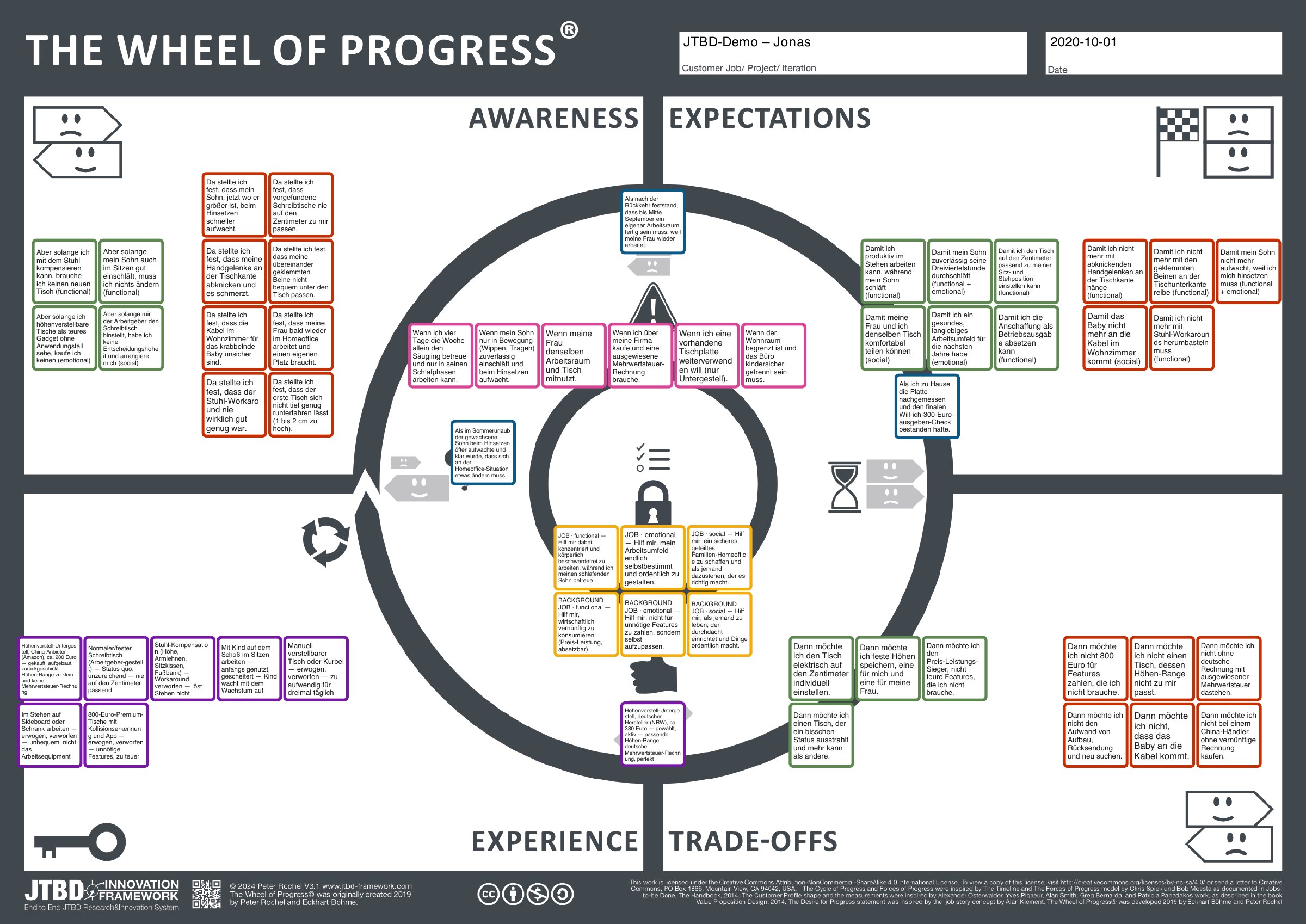
Three interviews are three cases, not yet a pattern. So the analysis shows you what these conversations say, but not whether others buy the same way. And we tell you so ourselves, before you notice it.
What your feedback looks like.
We look at five things: the right person, open storytelling, specific moments, the trigger and the whole story. It’s the conversation that is assessed, not you. Everything comes as a separate PDF, around one to two pages per interview.
Before we analyse, we look at each interview and check how it was conducted. To do that, we measure it against five questions.
| We ask | weak | strong | |
|---|---|---|---|
| 1 | The right person? Did they make the decision themselves? | only heard about it | made the decision themselves |
| 2 | Told openly? Do they talk about themselves or about “people in general”? | generalities, a front | honest self-observation |
| 3 | Specific moments? Are there scenes with a place and a time? | only opinions | situations you can date |
| 4 | Dug into the trigger? Why exactly on that day? | trigger remains unclear | trigger clearly worked out |
| 5 | The whole story? What pushed, what drew them in, what held them back, what kept them hanging on, from the first thought through to use? | gaps, no follow-up questions | everything asked, no loose ends |
If an interview doesn’t capture a buying decision, we don’t analyse it and tell you why. That always applies in three cases: if there’s no specific purchase, switch or decision to walk away, if the person neither made the decision nor was involved in it, or if there’s no verbatim recording or transcript, only notes taken during or after the conversation.
You get our feedback in any case, in words and with its point in the conversation. And it’s about how the conversation was led, not about the person who led it. In other words: it isn’t a report card; it shows you where your next interview can yield more. And if none of your interviews holds up, you get your money back.
Included:
Not included:
Promised: we look at what you describe and tell you openly if it isn’t a fit.
Then there’s no invoice. And we check every interview before we analyse it. If none holds up, you get your money back. Two working days after we have everything, the analysis is ready, with our feedback on how you conducted your interviews. And the results call with you.
Not promised: that every interview holds up to analysis.
The first look only sees your description, because no file comes to us before the engagement. And some gaps only show up in the full conversation. If an interview doesn’t capture a buying decision, we don’t analyse it, and you get our feedback on it instead. That way you know how to make the next interview hold up.
Not promised: a statement about all your customers.
Three interviews are three cases.
And not promised: any effect on your revenue, because you decide what you do with the analysis.
For comparison: the sprint, in which we conduct and analyse the interviews ourselves until there’s a pattern for your decision, starts at €16,500 net. The Buying-Reason Analysis is the step before that, with your own material. And if you go further, it is credited in full there.
€1,900 net, fixed price · up to three interviews from one project · €0 extra if you book the sprint within 30 days.
| If … | you pay for the analysis |
|---|---|
| you book the sprint within 30 days of the results call | €0 extra. The €1,900 is credited in full. |
| none of your interviews holds up to analysis | €0. You get your money back, plus our feedback on every interview. |
| only some of your interviews hold up to analysis | €1,900 net for analysing those. For the rest, you get our feedback. |
| you take the analysis and leave it at that | €1,900 net. The analysis is yours. |
In short: the €1,900 only stays on the bill if you have your analysis and go no further. And then you’ve turned your own work into a clear answer instead of leaving it lying around.
€1,900 net (plus VAT where applicable) · for customers in Germany: €2,261.00 including 19% VAT · payment in advance by invoice, with the confirmation of the engagement.
This offer is for businesses only.
Or write to us directly at jtbd@oberwasser-consulting.de.
Do you conduct interviews on an ongoing basis? For teams, there are volume allowances and packages. Ask about a volume allowance →
Then we tell you before we analyse. Once they’ve arrived, we assess every interview before we analyse it. And if one doesn’t capture a buying decision, we don’t analyse it. Instead, you get our feedback: what’s missing, why, and how to conduct the next interview. If none holds up, you get your money back. And then the Buying-Reason Finding is the better place to start. We conduct that one ourselves, with an interview that holds up. Or you learn in our training how to conduct it yourself.
No. But every interview has to trace one person’s specific purchase, switch or decision to walk away: the moment they started looking, and what finally made them buy or walk away. If it wasn’t conducted along Jobs to Be Done lines, the analysis is often thinner, and the feedback on how you conducted the interview tells you where and why. We don’t analyse opinion or satisfaction interviews, usability tests or group discussions, because there’s no decision in them to trace. And we clarify that during the first look, based on your description.
Ideally recordings, as audio or video. We transcribe them on our own computers, and every quote remains verifiable against the original audio. What matters is sound quality good enough to understand every word. A verbatim transcript works just as well, as long as it shows who says what, that is, with speaker labels. Then we check against the transcript. But notes taken during or after the conversation aren’t enough for an analysis, because they lack the verbatim evidence. And the conversations should have been conducted in German or English. You’re free to choose which language you get the analysis in: German or English, regardless of which of the two the interview was conducted in.
Then get in touch anyway. There are two routes: during the first look, we use your description to pick the three most promising and analyse them. Or you go for the sprint. With that many, it’s worth asking whether you’re looking for a pattern rather than individual cases, because that’s exactly what the sprint is for. And we clarify that during the first look.
In the Buying-Reason Finding, we find a real buyer, conduct the interview ourselves and set it against your assumptions. Here, though, you’ve already conducted the interviews, and we analyse them. Same price, different starting point. So the choice comes down to whether you already have material.
You can. If you know you need a pattern, the sprint is the direct route. But the analysis is for the moment before that: when you first want to see what’s in your own conversations. And if you go further within 30 days of the results call, you haven’t paid for anything twice.
You can. And anyone who does their own analysis learns a lot along the way. If you want to master it, our training is the better route. The analysis is for when a decision is coming up and you don’t want to put it off just because there’s no time for analysis right now. And for when you want to find out along the way how well your interviews were conducted.
That’s for your interviewees to decide, not us. If they have agreed to the recording and to it being passed on to a service provider, you confirm that to us in writing before the first file arrives. And before that, we sign the data processing agreement. But if that consent is missing, don’t send us the recordings.
Then we won’t analyse them for you. The interviews belong to your client, and we don’t produce analyses that are passed on under another name. If your client wants them analysed, they can engage us themselves.
They’re transcribed on our own computers, and only there. No external service gets them to transcribe. When we send you the data processing agreement, we also tell you how to send them to us. And 30 days after the results call, we delete recordings and transcripts, or sooner if you wish. If you book the sprint within that time, only after the sprint has ended.
€1,900
net (plus VAT where applicable) · for customers in Germany: €2,261.00 including 19% VAT · up to three interviews from one project · analysis two working days after we have everything.
A short email is enough: how many interviews, what they were about, which decision is coming up and what form the material is in. Don’t send any files yet, because they only come to us after the data processing agreement and your assurance. So first we tell you whether it’s a fit, and only then do things move forward.
Then let’s talk about a volume allowance or a package, tailored to your rhythm. Just tell us roughly how many interviews you conduct and who conducts them: Ask about a volume allowance →