
In-house workshop for your team, delivered in English – with Peter Rochel, creator of the JTBD Innovation Framework and the Progress Design Map.
8 modules
Dates for your team, by arrangement
English
Language of delivery
from €14,500
net, depending on group size
 01For whomYou know JTBD – what you lack is the tool
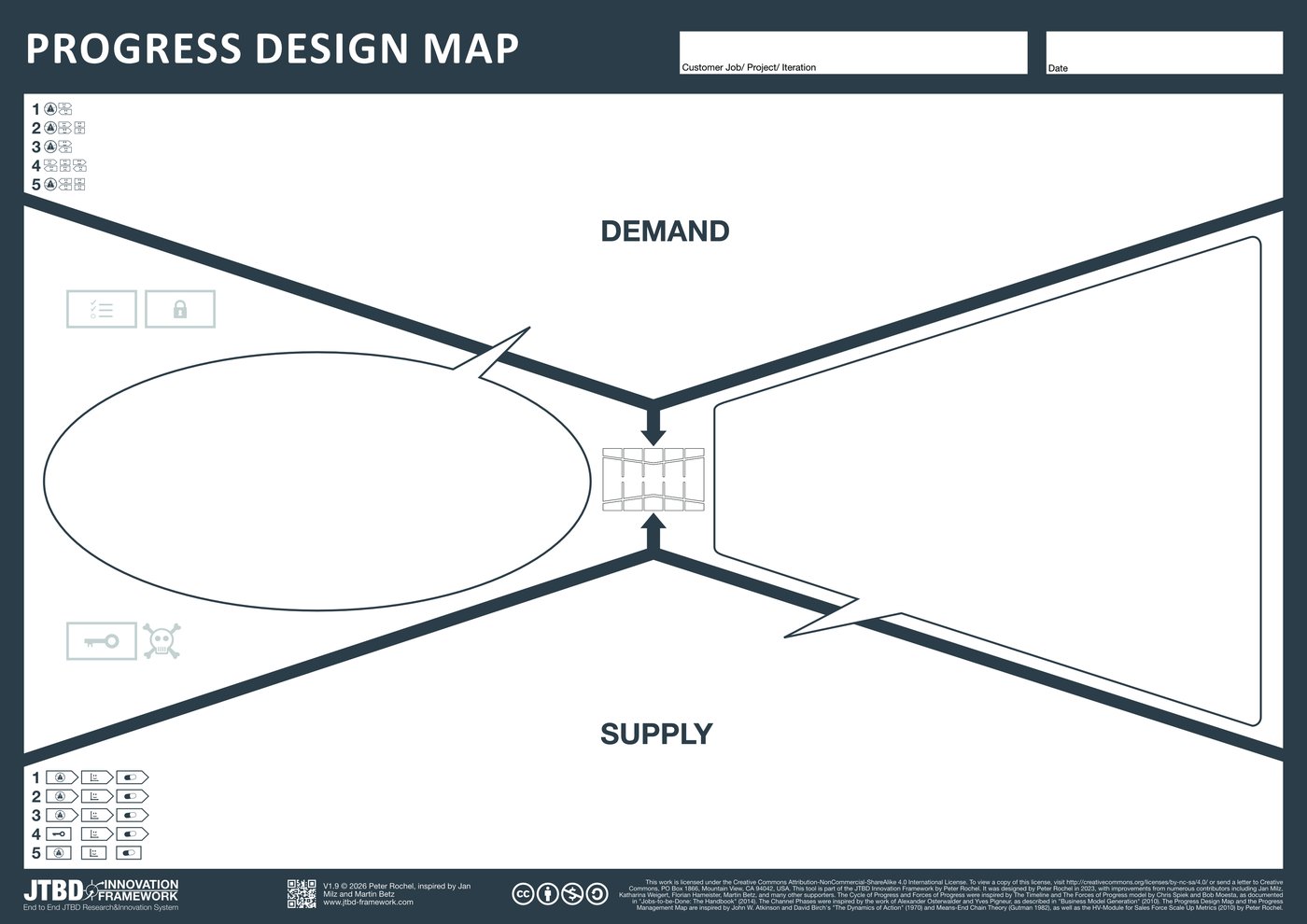
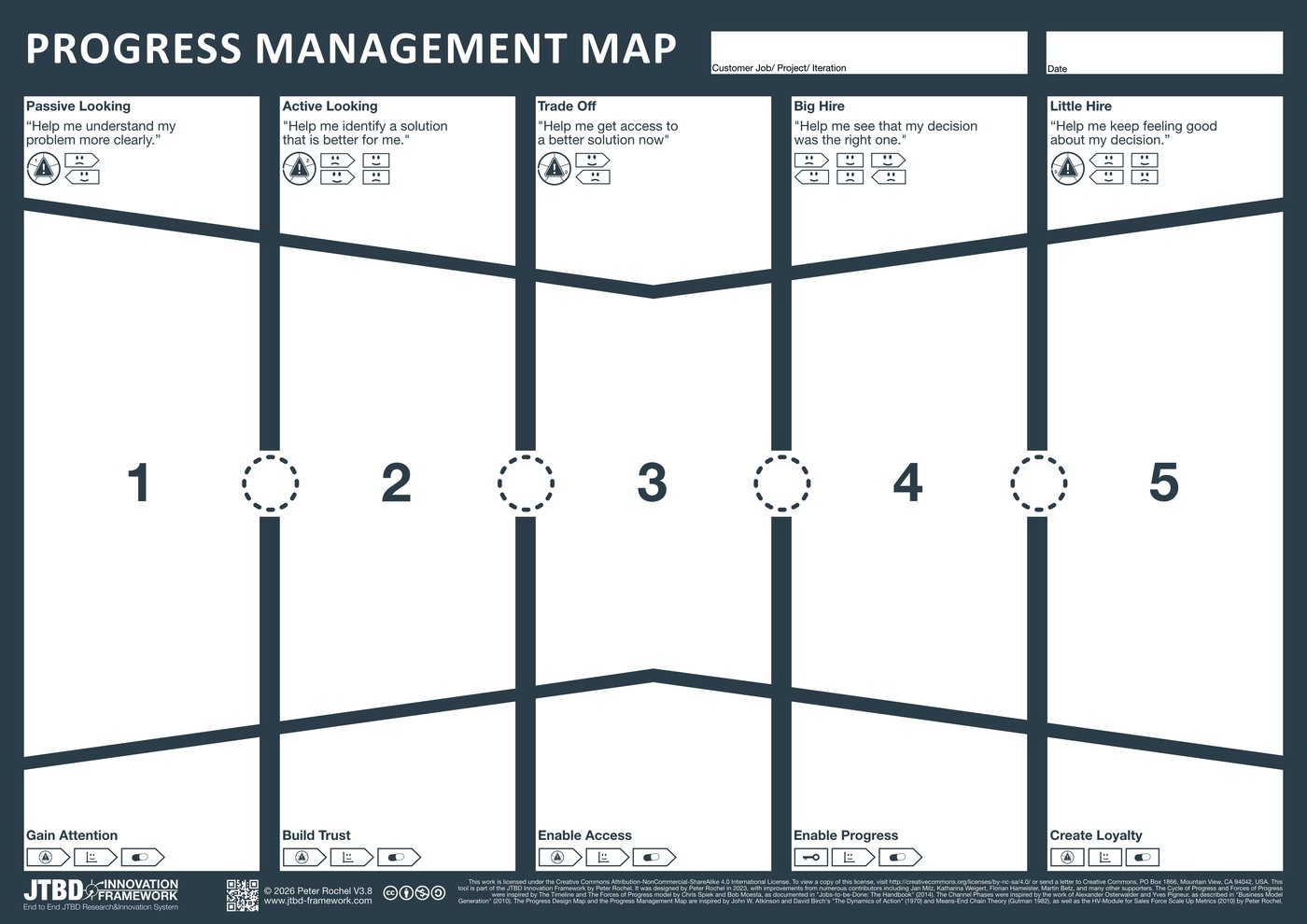
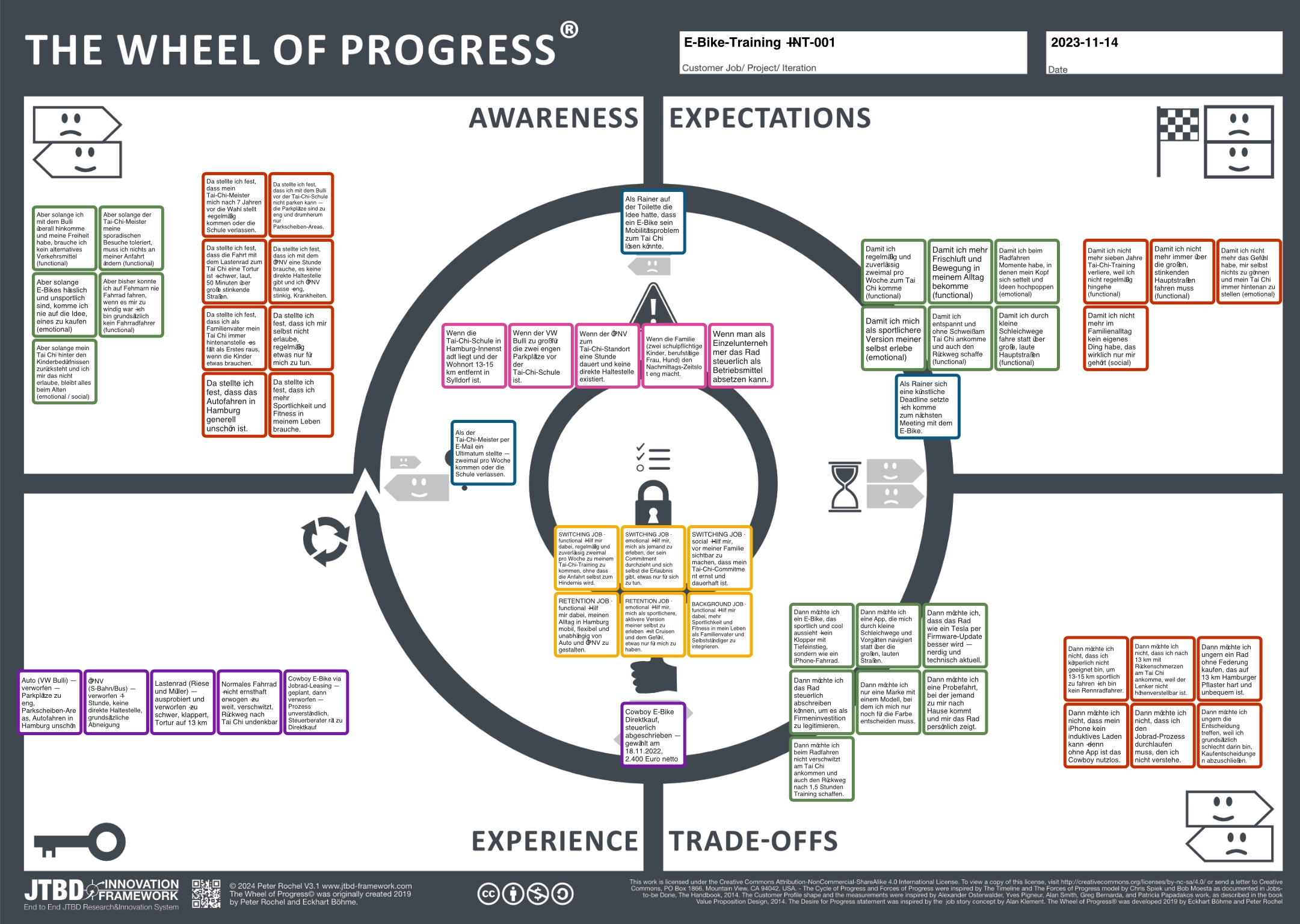 02ToolsWheel of Progress, Progress Design Map, Progress Management Map
 03What you can do afterwardsSix skills, one documented customer view
 05The eight modulesFrom foundations to transfer
 06In-house trainingYour own dates for your team · from €14,500 net
“Everyone knows we need to interview customers – but in the end, nobody has a tool for actually running an interview.”
“Until now, it always sounded perfectly sensible for clients – just not for me.”
“Of course, we have already thrown plenty of money out of the window on agencies and campaigns.”
Quotes translated from German.
If that sounds familiar, you are in the same position as many experienced consultants, trainers and innovation managers. Mastering JTBD starts exactly here.
Mastering JTBD is a workshop in which you learn to understand customer decisions systematically and turn that understanding into better product, marketing and sales decisions. AI is used deliberately as an assistant – within a clearly documented, legally sound process. Developed by Peter Rochel on the basis of more than 700 innovation and strategy projects since 2006.
700+
innovation and strategy projects since 2006
Mastering JTBD is built on the JTBD Innovation Framework – developed by Peter Rochel. Other workshops teach JTBD second-hand. Here you learn the method from the person who built it.
You work with tools you will not get in any other workshop:
More than 700 innovation and strategy projects since 2006. Peter is in ongoing professional exchange with Bob Moesta, co-architect of international JTBD theory. The method is globally connected – the tools were developed independently in the DACH region.
You keep investing in campaigns and agencies that never speak the language your target audiences use to describe their problems
You keep working with JTBD theory from books and podcasts – but without a tool you can apply in your day-to-day work
You keep building marketing and sales on hypotheses instead of evidence-based decision paths – and only notice when the next launch falls flat
After Mastering JTBD you can – together with your team:
For managing directors and boards, this means:
Decisions become easier to explain, easier to measure and rest on a documented customer view instead of whoever shouts loudest.
If you want to make better decisions, you have several routes. This overview helps you decide whether route 4 is the right one for you.
Decisions remain heavily dependent on individuals
Solid, but often expensive and slow
Fast and cheap
Real in-depth JTBD interviews with real people – you learn the craft in a live interview, not in a simulation
What you can use Mastering JTBD for in practice – from customer research to justifying decisions under risk.
Reach clear insights faster
Prioritise without endless debates
Messages that land where it counts
Unlock potential where it pays off
Stronger arguments for your decisions
By booking Mastering JTBD for your team you get:

Eight live modules, on dates agreed with your team. You work through the method on your own real question, not on a made-up example.

Modules 1–2 Foundations
M1
Customers never choose the best product – they choose the least-bad compromise in a specific situation. Under what conditions do they switch at all?
M2
Most of what you think you know about your customers is an assumption – how do you check what is actually real?
Modules 3–4 Interview
M3
How do you get people to tell their switching story so that you actually recognise events, forces and context – instead of collecting opinions?
M4
Which hypotheses leap out at you from a real interview that you never saw in the script?

Modules 5–6 Analysis
M5
How do you turn ten interviews into robust patterns without drowning in the data?
M6
How do you turn your interview patterns into a basis for decisions your team can commit to?

Modules 7–8 Implementation
M7
How do you translate interviews into messages, experiments and a business model that sells?
M8
Why do most JTBD initiatives fail – not because of the method, but because of the day after?
M3+/M4+
Bookable separately.
For special cases where real interviewees are unavailable or out of reach: how to set up AI-based customer personas so that the results are useful despite every caveat.
Documenting assumptions and limits instead of hiding them – and knowing exactly when this method holds up and when it does not. An easy way into JTBD research, not a substitute for real conversations.
You learn JTBD in real conversations. Synthetic AI interviews are available as an optional deep-dive module – not as the main route.
Your own dates for your team. From €14,500 net, depending on group size.
Delivered in English – online or on-site, by arrangement.
Mastering JTBD is not the right format for you if:
you are encountering JTBD for the first time – for a first introduction, our sprint briefing is the better route
you need to make a specific quarterly decision and want help with it – the Customer Insights Sprint is the right format for that
you have no time to work continuously on your own question during the workshop – Mastering JTBD is learning by doing, not a lecture course
Co-founderB2B cybersecurity provider“The principle behind JTBD, developed at Harvard University, completely shifted my perspective on market needs and customer loyalty. But no one there showed you how to actually apply it. Peter Rochel’s JTBD Innovation Framework changed the game in that respect.”
Nils WlokaCPTO, Steadybit“Right from the start it became clear to me how valuable the qualitative research – and especially the Wheel of Progress combined with the channel phase model – is for strategic business decisions. It has revolutionised our corporate communications, customer approach and sales strategy. A real game changer!”
Michael von PidollTÜV Rheinland AG“The clear presentation of the JTBD methodology and the expertise in the interviews gave us valuable insights for optimising our product development and addressing customer needs more effectively.”
Quotes from Nils Wloka, Michael von Pidoll and previous participants translated from German.
“I already had my own interview techniques, which were similar in some respects … but it gave me a great deal more structure, and I would like to keep using it this way.”
Matthias, participant with his own interview experience · Mastering JTBD 09/2025
“I am about to run online marketing ads and put budget behind them, and I feel better prepared than if I were just fumbling around in the dark. … This way it is simply a bit more valid.”
Sabine, provider with her own offering · Mastering JTBD 09/2025
This is what a fully analysed conversation looks like – exactly what you will learn to produce yourself in the training:
Mastering JTBD was developed by Peter Rochel on the basis of his work on more than 700 innovation and strategy projects since 2006. Other workshops teach JTBD second-hand or replace the customer conversation with AI simulations.
Here you learn JTBD in real conversations with real people – and you learn it from the creator of the framework and its tools: the Wheel of Progress (co-created with Eckhart Böhme), the Progress Design Map and the Progress Management Map. Peter is in ongoing professional exchange with Bob Moesta, co-architect of international JTBD theory.
Mastering JTBD is aimed at people who already know JTBD from books, podcasts or their own practice – and now want to apply it independently in their own work. If you are encountering JTBD for the first time, our sprint briefing or the Customer Insights Sprint is the better starting point.
Between the modules, plan for 1–2 hours applying the method to your own question. Mastering JTBD is learning by doing – you work through the method on your own project, not on a made-up example.
Modules can be recorded by arrangement. Where they are, you can catch up on anything you miss, but the live format gives you the direct opportunity to ask questions and practise. We recommend attending at least 6 of the 8 live modules.
Both – but not in equal measure. The standard is real in-depth JTBD interviews with real people. In Module 4 we run a live interview with a real interviewee and analyse it together – that is the core.
We use AI deliberately as an assistant: for research, analysis, documentation and pattern recognition afterwards. Synthetic interviews with AI personas are available as an optional deep-dive module (bookable separately) – useful for special cases where real interviewees are out of reach. They do not replace the real conversation.

Customer centricity does not start with gut feeling – it starts with clear, traceable insights.