
An established IT services firm in Australia with around 60 employees was facing a strategic decision. The company – in business for more than 20 years, a Gold partner of a major software ecosystem and a Platinum partner of a major telecommunications provider – had made a name for itself as a managed service provider for mid-sized businesses.
But clients were moving to the cloud, and a major vendor had begun offering to manage clients’ computers directly. The helpdesk would shrink. The firm hadn’t lost any clients yet, but the COO could see it coming. Award-winning competitors were moving into AI or the Internet of Things. Cybersecurity, a market full of solutions, was the hardest of all for him: ‘I don’t know what I should be selling.’
‘So what should we be doing because I see this is eroding. What should we be doing?’
The COO of the IT services firm on his core business
He knew Jobs to Be Done from Bob Moesta’s and Tony Ulwick’s courses. What he hadn’t yet done was apply it to his own market. Then he wrote to Oberwasser Consulting: he was familiar with JTBD, he said, and wanted help with the interviews and with distilling the results, so that he could pin down solid jobs for his services. He wanted to understand why clients really hired his firm, and to turn that into new packages and add-on products of his own: ‘That will be my IP.’
Australia’s cybersecurity market is growing by 10–14% a year. Suddenly every IT provider is putting ‘security’ on its website. Without a point of difference, providers risk becoming interchangeable.
The risk was not only financial. For 20 years, the firm had worked mainly on its clients’ IT infrastructure. Now the COO suspected that its existing skills were no longer relevant. By his own account, he understood only ‘at a high level’ why clients hired the firm for applications.
The alternative: investing in a market entry that misses how the target group actually buys. Or worse – slowly becoming irrelevant while telling yourself that knowing is enough.
The COO got in touch at the end of September 2021, and work began a week later. He didn’t cautiously book a single workshop. He booked the full programme: the sprint, the training and six months of support.
The Customer Insights Sprint and the Mastering JTBD training ran at the same time. That was by design, not by chance: holding real buyer interviews during the day while learning to put the results to strategic use. Over the six-week sprint and the six months of support, Peter Rochel thought things through, made decisions and shared responsibility with the client.
We then helped turn the insights into real business decisions: product development, positioning, sales process, communication strategy. Not ‘here are your results, good luck’ – but ‘we’ll stay until the decisions have been made and put into practice’.
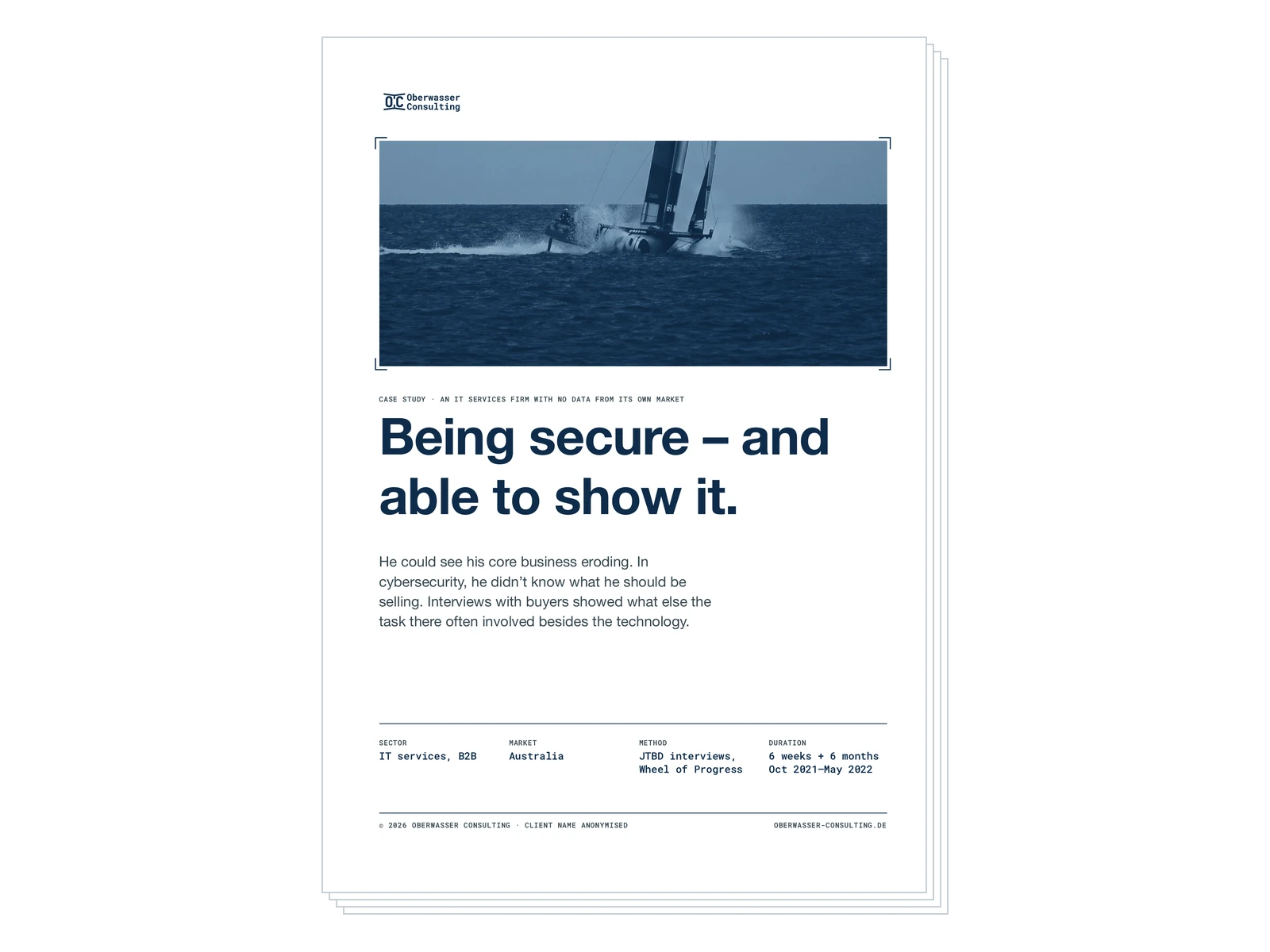
The case study as a PDF (7 pages): background, project, two buyer types and the key insight. Download it free – no sign-up needed, link at the end of this page.
‘They loved it.’
Head of IT at a professional body, on his board’s reaction to the security reports he had put together
In three of six buyer interviews, the people responsible for IT described similar pressure: a board, an auditor or a client asked for proof. One head of IT used the reports from his monitoring service and his own systems to answer that request. A great deal changed on the technical side, too. What the industry talked about: technology and features. What three of the six also needed: something to show the board, auditors and clients. In the other three interviews, this pressure was mentioned only in passing, if at all.
‘What we find in the market is cyber security. Okay, I’ll give you email protection, I’ll give you this, I’ll give you that. We’re only talking about the tools, that’s a functionality and not even understanding what they want.’
The COO of the IT services firm on the industry
‘It was a blessing and a curse that we had that incident.’
Head of IT at a professional body
Security incidents came up in several interviews. One head of IT said that after the incident he found it fairly easy to get approval to spend money on protection. Where there had not yet been an incident, he said, you could only hope that the decision-makers understood what was at stake anyway. Another person responsible for IT built up his incident response plan with his team, one incident at a time.
‘He’s almost like an employee now. He’s got that much […] knowledge about how we operate […].’
One head of IT described his outsourced security lead (CISO-as-a-Service) as ‘almost like an employee’, because he knew their processes so well.
Segment 1 – The IT professional who carries responsibility: has the expertise, but no budget. Has to sell cybersecurity internally as if on ‘Shark Tank’. Needs a case to put to the board.
‘It’s like looking after a child […]. If you don’t do it and they get run over by a car, then there’s problems.’
Head of IT at a group of companies
Segment 2 – The non-technical security buyer: carries the responsibility, but can’t judge what ‘good’ looks like. Lives with constant unease – until an incident exposes how vulnerable they are.
Before: cybersecurity as a technical add-on. No primary data. The role of a managed service provider looking after networks and computers.
After: a separate cybersecurity unit with its own brand. Its own primary data: two segments, each with a distinct buying logic. A new identity as a ‘Technology Success Partner’.
‘It’s a huge difference between selling and letting buy. I want to let them buy instead of trying to sell something. […] And I have learned that staff also don’t like having to sell something. They love to let buy.’
The COO on the turning point
The transformation was not only strategic. It was personal. Looking back, the COO said: ‘I’ve been in this business 20 years and […] if I haven’t thought about emotional jobs and social jobs then for me it’s like what am I stupid?’
In November 2021, after 6 weeks, the primary data was in. In May 2022, at the end of the six months of support, the new strategy was in place and being put into practice. Today, a few years on, what was a single IT services firm has become an international group with three business lines: the original IT services firm, a separate cybersecurity unit as a sister company, and an AI consultancy founded in 2024. The company has staff in five countries – Australia, the Philippines, the USA, the UK and India – and has repositioned itself from managed service provider to ‘Technology Success Partner’.
‘Since we spoke in […] December or something, I’ve probably hired eight people.’
The COO on growth
The market is growing at a double-digit rate. In 2024, an AI consultancy was added as a unit of its own.
Most consulting projects end at slide 47 of a presentation. This one didn’t.
What mattered was not that three building blocks were booked, but how they worked together: sprint and training in parallel over 6 weeks. The COO didn’t just analyse data – he learned to use it strategically at the same time.
‘Watching is one, and then when I’m doing it with an exercise, it’s different. […] they probably didn’t go through as much as the nuances […].’
The COO on the difference from earlier training courses
The six months of Evidence-to-Impact support made sure that insights turned into real business decisions.
‘I realize that now only because when I change myself in my thinking about something, about project management, it’s not going to just sit in the project management that I’m doing for this software. But if I’m doing a telephony, it’ll be the same thinking that will go through there as well.’
The COO on the lasting effect
The case study in 7 pages: background, project, two buyer types and the key insight – structured, quotable and ready to pass on to your team.
In this case, work began in early October 2021, a week after the first enquiry. The Customer Insights Sprint and the Mastering JTBD training ran in parallel for 6 weeks, until November 2021. This was followed by 6 months of Evidence-to-Impact support, until May 2022. Within 6 weeks, the primary data and the first strategic insights were in.
Jobs to Be Done works in any industry – the method looks at buying decisions, not industries. Peter Rochel has used JTBD in more than 700 projects since 2006, from yoga mats and bicycle retail to B2B cybersecurity. What matters is not the industry but whether you are facing a decision about a product, your strategy or your positioning.
The COO in this case study had learned from Ulwick and Moesta. Even so, he had no data from his own market. The difference: theory explains what JTBD is. Interviews with your buyers show you how to use it to make decisions for your business. You can learn the method itself in the Mastering JTBD training. The Buying-Reason Finding starts with one real buyer in an interview.
JTBD in-depth interviews reconstruct real buying decisions. That often brings to light what you can’t see from the inside. And if an interview confirms your assumptions, that is a result too: you then know rather than assume. In this case, in three of six buyer interviews, the people responsible for IT said that a board, an auditor or a client had asked them for proof. For them, being able to show something was part of the task, alongside the technology, where a great deal changed in all six cases.
In this project, 6 structured in-depth interviews were enough to identify two clearly distinct buyer segments. In general, robust patterns emerge after 6–12 interviews. What matters is the depth of each interview (60–90 minutes), not the number.
Here it was cybersecurity. For you, it might be AI, sustainability or platform strategy: a market where you are technically strong but don’t know why buyers choose you – or go elsewhere. Do you know what else your buyers have to get done alongside your service?
The Buying-Reason Finding: a real buyer, interviewed and checked against your assumptions. In this case, the sprint involved six interviews. For you, it starts with a list of what you believe today – and one interview.
View the Buying-Reason Finding
Need to know how your customers buy across the board, as in this case? Then the Customer Insights Sprint is the direct route. Prefer to find out more first? Podcast with real cases (many episodes in German)