
11. August 2026
Hypothesis-Driven Working
11 min read
Your team has been debating priorities for weeks, but nobody has spoken to a customer. The roadmap is built on stakeholder opinions, not evidence. And the last product launch? It missed the target audience.
What does Jobs-to-be-Done research actually look like?
See it in a real case: the 2026 Bitcoin Adoption Study – 35 in-depth interviews, 6 buyer segments, 1,207 coded evidence cards, analysed with the Wheel of Progress. No personas, no gut feeling – documented job logic you can base decisions on.
View the study → (in German)Hypothesis-driven working is the counter-programme to gut-feel decision-making. It is a structured approach: systematically uncover blind spots, test critical assumptions, and only act once you have evidence – not consensus. Combined with JTBD interviews (in German), it becomes the sharpest weapon against the most expensive source of error in any business: decisions built on assumptions nobody has tested.
Video: hypothesis-driven working explained in 6 minutes
In this JTBD podcast shot, Peter Rochel explains what hypothesis-driven working is. In just under 6 minutes, Peter shows you what to look out for and shares valuable tips and tricks that will save you time, nerves and money.



Listen to I+U season 2, episode 039 right here
All chapter timestamps for this episode:
00:00:00 Intro
00:00:25 Clarification
00:01:56 5 steps
00:02:51 Four possible outcomes
00:04:29 Tools
00:05:41 Get out
More episodes on this topic right here
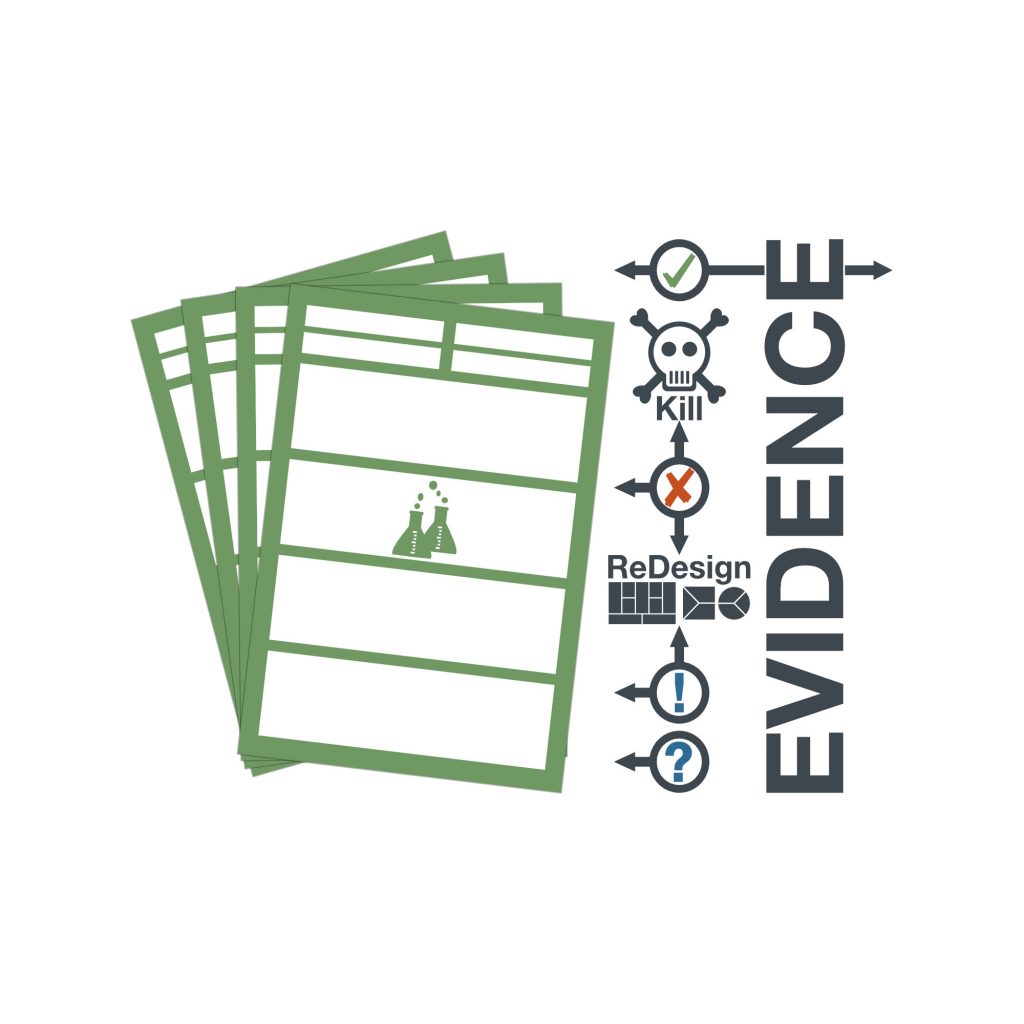
- Test and learning cards for documenting hypotheses and insights in the Statty Shop
- Free template for a JTBD hypothesis
- Tools for conducting and documenting Jobs to Be Done customer interviews
When hypothesis-driven working makes the difference
In practice, I keep seeing the same situations: teams believe they understand their customers – yet do not stand on a single tested hypothesis:
- “We know what our customers want” – but the last real customer research was three years ago, and the market has moved on since.
- “Sales asked for the feature” – stakeholder wishes are not customer evidence. They are supply-side thinking (in German).
- “Our competitors do it too” – copying competitors is the opposite of innovation. It means adopting other people’s untested assumptions.
- “We had no time for customer research” – but time for three feature iterations nobody uses? A Customer Insights Sprint (in German) takes four weeks and saves months.
Hypothesis-driven working is the antidote: you write down what you believe you know. You define what would prove you wrong. And then you test – with real customers, real data, real decisions.
The podcast episode in detail
In this Innovate+Upgrade Shot, Peter Rochel explains in 6 minutes the five steps of hypothesis-driven working, the four possible test outcomes and which tools work best in practice.
There are five steps to working hypothesis-driven:
- Define your hypothesis.
- Consider how you can test the hypothesis.
- Plan how and what you want to measure.
- Set criteria for judging whether your hypothesis has been confirmed or refuted.
- Allow for the four possible outcomes: hypothesis confirmed, hypothesis refuted, inconclusive result or new insights.
Tools
There are various tools that can help you work hypothesis-driven – for example the test cards, learning cards, screener cards and assumption map we use.
If you are interested in delivering innovation and transformation with Jobs to be Done and want to win enthusiastic customers and employees, do get in touch. We offer workshops, sprints (in German) and training programmes aimed at exactly that.
You can read the full transcript of this podcast here:
This Shot is about hypothesis-driven working: what exactly it is, how it works, why it is so important and which tools can help.
Welcome to an Innovate & Upgrade Shot.
Here we take a short, punchy look at very practical questions around customer interviews, Jobs to Be Done and The Wheel of Progress.
My name is Peter Rochel – and here we go.
For me, hypothesis-driven working is a structured approach to systematically identifying, assessing and eliminating blind spots.
And all of this matters above all when you are venturing into uncertain territory – it is especially important in innovation or exploration mode, because we tend to deceive ourselves.
That is, we cling to our cherished habits, just as all people do, and of course we all have a strong, unconscious attachment to our own beliefs and pet ideas.
Letting go of them is very, very difficult – all the more reason to have a structured approach that lets us recognise our own assumptions, assess them, weigh them, classify them, document them and then also see our own progress.
Especially when working with Jobs-to-be-Done theory and the methods that go with it, such as working with the Wheel of Progress, it very often happens that your own beliefs quickly come under threat.
So all the more reason to tackle things there with a hypothesis-driven approach.
Which makes it all the more important to get a clear view of it and not blind yourself.
Really important.
And you can picture the whole thing working quite well in five steps.
The first is to define the hypothesis in the first place – to write down what you as a team actually believe, or what you yourself believe, what you think is right.
Second, think about how you can test it.
Third, think about how you want to measure it – or what you actually want to measure.
Then think about which criteria you will apply so that you have evidence to say: OK, if this happens and I measure this, I am right – and if I measure that, I am wrong.
So: define criteria.
And finally, remind yourself that when you work hypothesis-driven in this way – you have defined your hypothesis, defined your assumption, you have measured it, you have tested it – you can in principle get four different outcomes.
You may find: OK, the assumption holds, I was right, and now I have somewhat stronger evidence for it, because I ran an experiment and was able to confirm it.
The second variant is that your experiment could not confirm the assumption and in fact actually refuted it.
Then you have three options.
Either you throw it out, go back into your business model design or your value proposition design – or whatever it is you are doing, your channel design – and start again from the beginning, thinking about what you need to do instead.
And the third variant, if the test has refuted your assumption, would be to test differently if need be and run a further experiment.
So: the first possibility was hypothesis confirmed, the second possibility was hypothesis refuted.
The third possibility is that you get an inconclusive result.
And that means you will probably have to test again, because perhaps your measurement criteria were sloppy, or the test was not suitable for checking the assumption – or, or, or.
And when something is unclear, you have no choice: you have to test again.
The fourth possible outcome is that, on top of that, you gain a completely new insight – something you did not know at all before.
And that in turn means you can build it back into your business model design, your product design or your marketing, depending on what you tested.
As for tools you can use for this, tools that help – ones I use myself, that we use – it depends on whether you are working online or offline.
The offline versions are well worth a look, and they are not expensive either.
There are, for example, test cards from Strategyzer, which are excellent for practising this a little.
How do you actually formulate sound hypotheses and test criteria and all the rest of it?
Then there are learning cards, where you can also document any new insights you have gained and what exactly they look like.
Then we have our screener cards, which we use to identify Jobs-to-be-Done interview candidates – essentially a special kind of test or hypothesis card that we use there.
And then there is also the assumption map – whether you really need it is open to debate, but it is basically a matrix where you can assess your assumptions once more: OK, are they important or unimportant, do I already have certainty here or not? Then you can more or less sort them and decide what you really need to test, what you can build straight into your business model design, your product design or your marketing, and what does not matter anyway and can simply be left alone.
That is it for today. And if you are now thinking, hey, I finally want to deliver innovation and transformation with Jobs to be Done too – so that you always have enough delighted paying customers, and enthusiastic employees who genuinely want to do a really good job with you for the long term – then get in touch with me, because that is exactly what I can help you with, for example through our workshops, sprints and training programmes.
Because that is precisely what we do – and it does not matter how small or large your company is, in almost any industry, in German, English or Spanish.
You will find all the links and ways to contact me in the show notes, and of course I would be delighted if you recommend this podcast to others, or even rate it and give me feedback.
Thank you for your time – and hopefully see you soon.
Frequently asked questions
Where does your decision process get stuck?
Hypothesis-driven working starts with an honest stocktake. The Decision Loop Check shows you in 10 minutes where your decision process is losing customers – and what you can change in concrete terms.
Free PDF workbook – sent straight to your inbox. No spam, unsubscribe at any time.
Hypothesis-driven working means basing decisions not on assumptions or gut feeling but on tested hypotheses. You formulate a clear thesis (e.g. “Our customers buy because of X”), test it against real evidence – and only then act. The opposite is opinion-based working, which regularly steers companies in the wrong direction.
In five steps: (1) Formulate the hypothesis – what do you believe you know? (2) Define test criteria – what would prove you wrong? (3) Gather evidence – through JTBD interviews (in German), data, observation. (4) Validate or discard the hypothesis. (5) Make the decision – this time with backing.
JTBD is the tool for testing hypotheses about customer motivation. Most assumptions about “why do customers buy?” are wrong – not because teams are naive, but because supply-side thinking distorts the view. JTBD interviews deliver the evidence that either confirms or refutes hypotheses.
For every team that makes strategic decisions: product development, marketing, sales, senior management. Wherever assumptions become expensive – new products, repositioning, market entry, budget allocation – hypothesis-driven working measurably reduces the risk.
Related symptom diagnosis: What helps when your hypothesis is not confirmed? Three projects show why the assumed buying barrier is almost never the real one: Why do customers not buy, even though the product is good? (in German)
When the method is applied under deadline pressure
Hypothesis-driven prioritisation is a thinking and decision-making tool. If the quarterly presentation is due in 4–8 weeks and the data is missing, a Customer Insights Sprint delivers evidence that holds up internally – in 4–6 weeks, with a stakeholder-ready one-page briefing.
→ If you have to decide this quarter, assumptions are not a basis (in German)
Background: If you work hypothesis-driven, you test assumptions – if you want to know why decisions are made in the first place, look at the mechanics behind buying decisions.
If you test assumptions, you want to know what is actually moving in the field. That is exactly what the OC Radar is for: every two weeks, two or three signals at the intersection of AI and customer understanding, plus a case from our ongoing research.
→ Subscribe to the OC Radar (in German)
Subscribers receive each new episode automatically!
To get every new episode automatically on your player before all others, subscribe to Innovate+Upgrade 100% for free! e.g. at: