11. August 2026
Trigger Events in the JTBD Progress Cycle
8 min read
What is an event on the timeline, and which ones are there?
Listen to I+U season 2, episode 017 right here
00:00:00 Intro
00:01:07 What events are
00:01:36 Event types in the progress cycle
00:04:46 What events are needed for
00:05:45 Get out
Subscribe to the podcast for free here:



Event wanted: the trigger for the next behavioural pattern
Events are the triggers for new phases on the progress cycle, or timeline.
Good examples of a JTBD event might be: “finds out that…”, or “is given the brief to…”, or “…then someone tells them that” and so on. The same applies to all of these events: they trigger the next phase in the progress cycle.
Five events in the JTBD progress cycle
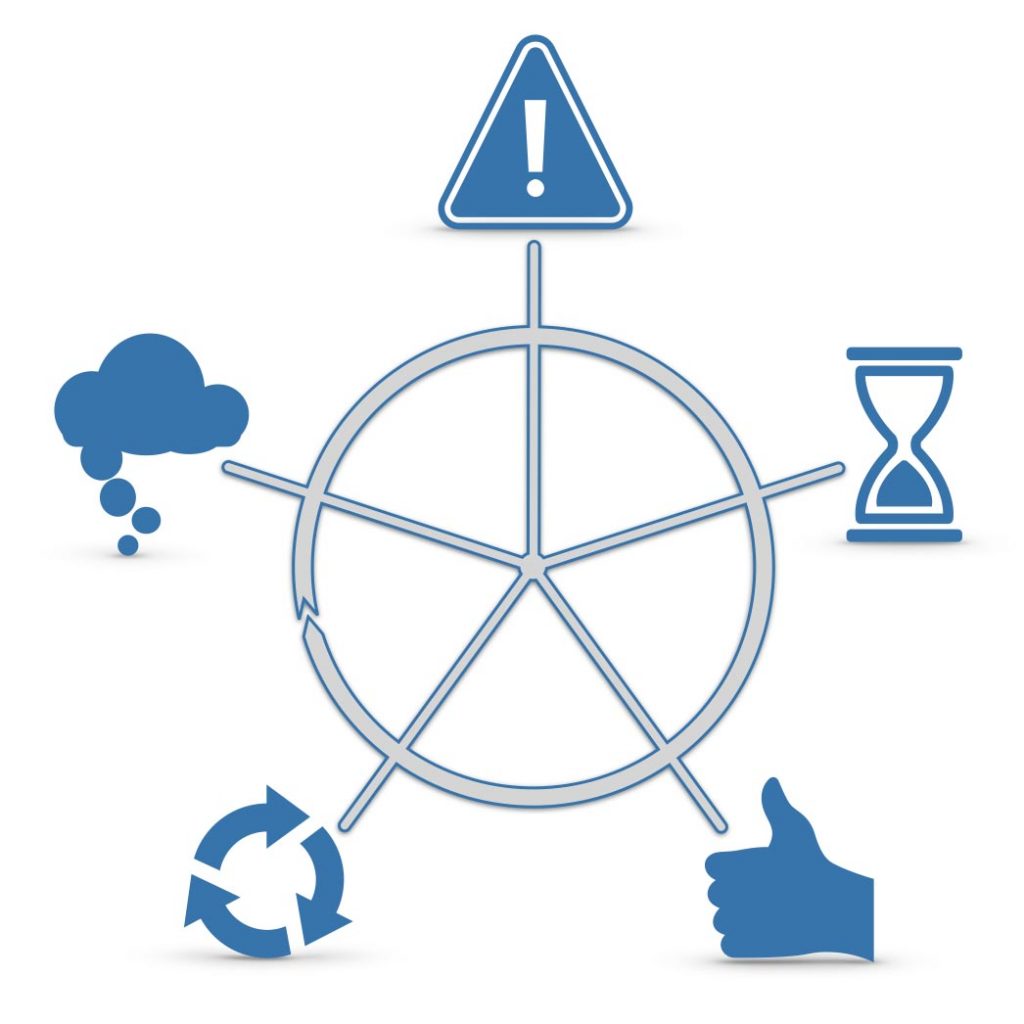
- First thought (cloud)
- Event 1 (exclamation mark)
- Event 2 (hourglass)
- Hiring (thumb)
- Repeat hiring (circular arrows)
Progress happens in cycles. Every cycle begins with a first thought and ends with repeat hiring, before a new cycle starts.
Five phases in every progress cycle
Each of these five events triggers a phase. Without an event, there is no progress into the next phase.
- Passive looking (eye)
- Active looking (binoculars)
- Deciding (tick)
- First use (stars)
- Repeat use (flag+bowl)
In every phase of a progress cycle around the job to be done (customer job/ JTBD), specific topics are relevant. The events mark the exact moment from which each topic becomes relevant for people with that JTBD.
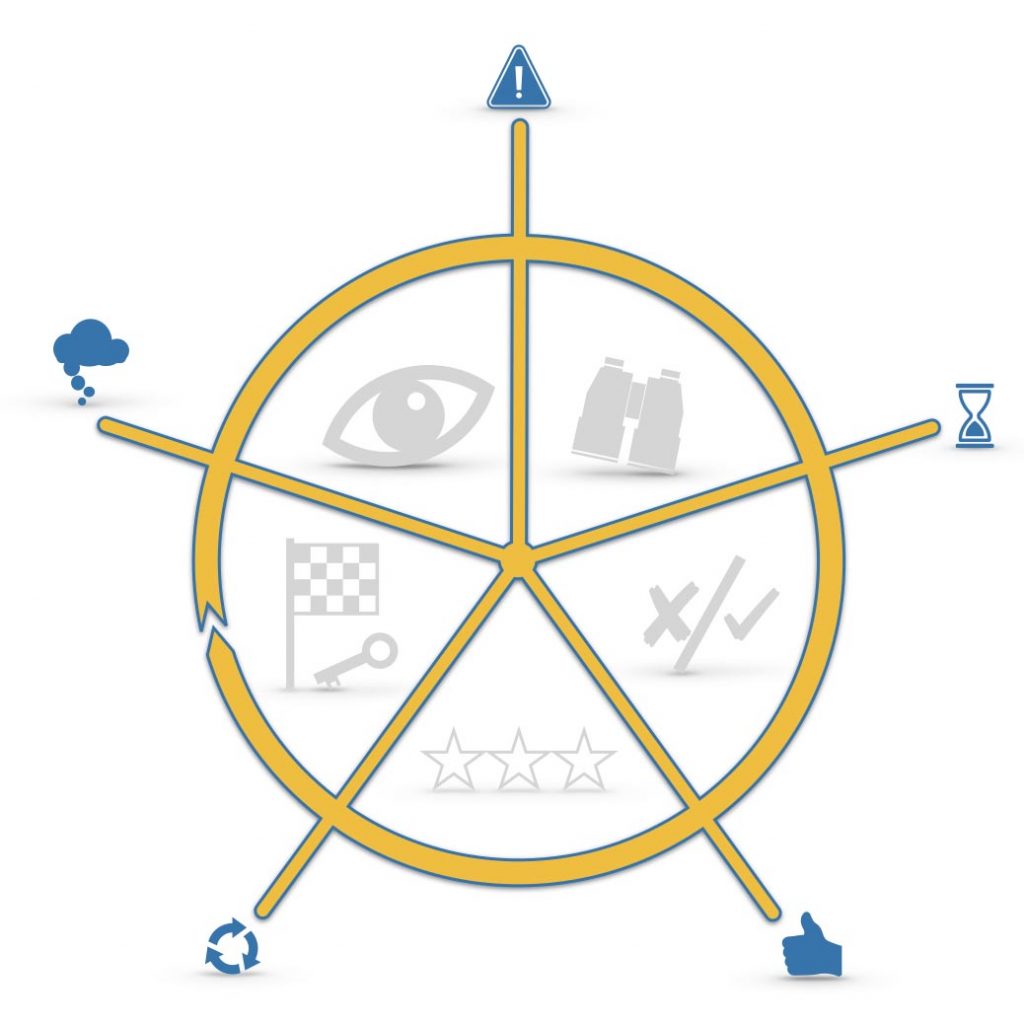
JTBD hack: know what is relevant to customers, and when
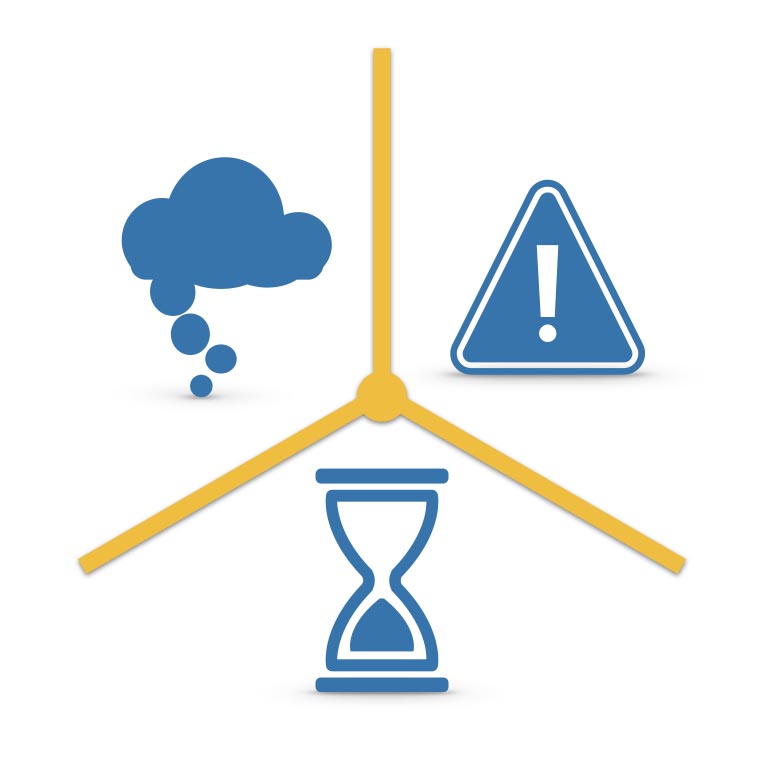
3 events that are essential above all for winning new customers: first thought, event 1 and event 2.
These three events form a causal chain that leads to a product being hired. Knowing the customer job (JTBD) and just one of these events is enough to improve your return on marketing investment (ROMI) and your customer acquisition costs (CAC).
Events are the tuning kit for channel phases in your business model
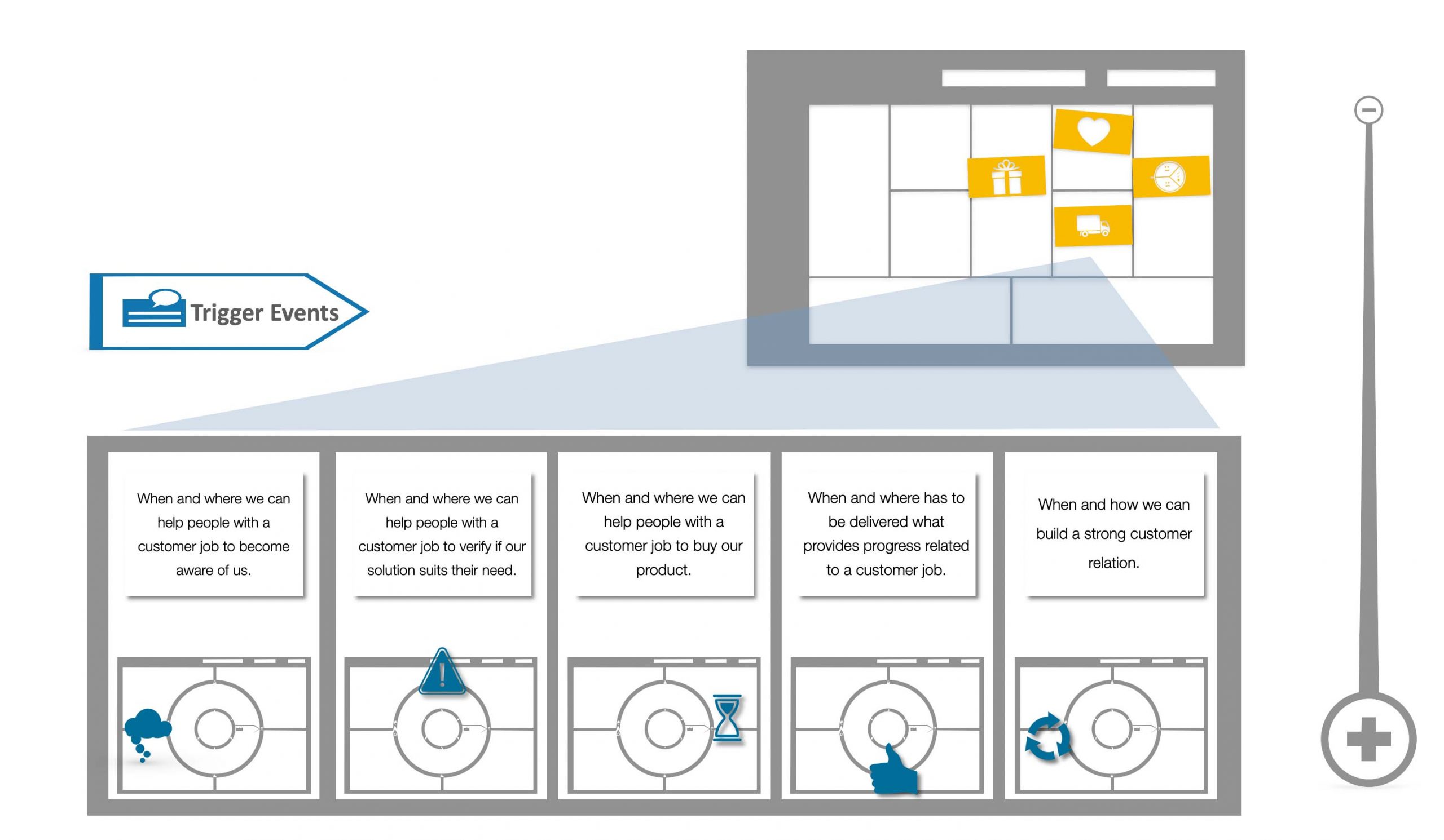
See and understand the whole picture: the JTBD Canvas
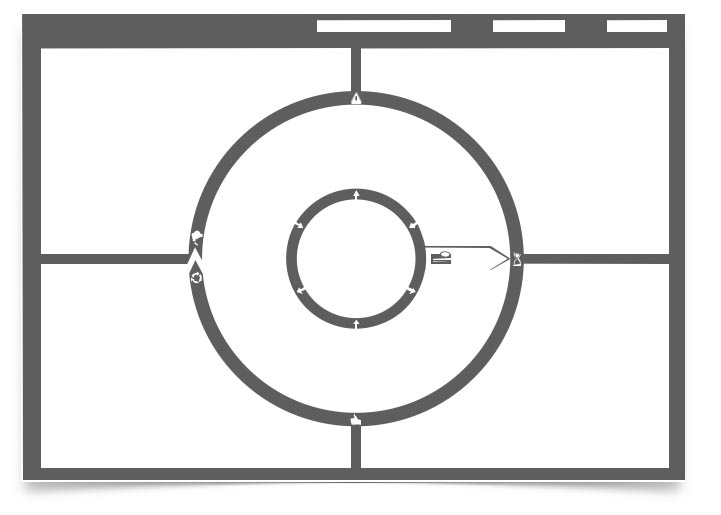
Helps you describe customer jobs as simply as possible and as precisely as necessary: The Wheel of Progress canvas
More episodes on this, right here
- Here Peter Rochel explains in four minutes what else, besides events, makes up a Job to be Done
- Here Stefan Hück reports how he markedly improved ROMI and CAC at Mantrafant by using customer jobs in marketing (in German)
The full transcript of the podcast episode on events on the timeline (English translation)
Let’s talk about events.
Welcome to an Innovate & Upgrade shot.
Short and to the point, this is about very practical questions around customer interviews, Jobs to be Done and the Wheel of Progress.
My name is Peter Rochel – let’s get started.
Why events, of all things?
First, because in my Jobs to be Done interviews events are always the first thing I try to find – and that is what I advise everyone else to do as well.
We’ll get to the reasons in a moment.
And second, why events today?
Because this is exactly the point where I very often see people who conduct Jobs to be Done interviews, or are just starting to, confuse events with behaviour.
Which means they notice and write down that Peter, for example, is searching the internet for Jobs to be Done training.
That gets noted down, along with the search terms used and whatever else people google or do.
But that is not what gets us anywhere at this point, when we need to find the events for the jobs.
Back up for a moment: what are events in the first place?
On the cycle of progress – or the timeline, as you could also call it, though I prefer to speak of a cycle – events are essentially the dominoes that have to fall one after another before a new or different solution gets hired for a specific job to be done, seen from the customer’s perspective.
And trigger here means the trigger for a new phase on this cycle.
These phases are: first, passive looking; second, active looking; third, deciding; fourth, use.
Which means triggers are triggers for a different kind of behaviour.
The trigger for the passive looking phase is the event that made me suddenly notice a particular topic.
The topic was always there – it just never caught my eye.
For example, my trusted mechanic says to me when I pick up my car after its service: “…listen, Peter, this thing isn’t looking too good any more. We’ll probably get it through the MOT one more time, but you’d better start thinking about whether it’s time for something new. The trouble I’ve already seen here – at some point it just won’t make economic sense any more.“
And suddenly I notice new cars of a certain brand, or whatever it may be, on the street. I never saw them before – they were always there, but without that comment from my mechanic I would never have noticed them.
So that is a classic trigger.
And it is exactly this trigger we need. Not the fact that I see those cars – we need that too, but somewhere else, not for events.
The second event: the trigger for the active looking. What else happened before I start actively looking around for new cars, researching online, maybe going to a dealer to ask for a price list, or having a look at a model, or something like that?
What happened before that – what else had to happen besides that comment?
And if we can answer that question, we have what in our language is event number 1.
The last event – or rather, not the last, but the next important one – is the trigger for the decision.
Once I have looked around at all sorts of dealers and done my homework online – what else has to happen before I buy a new car?
It is not as if I simply wake up one morning and think: right, today I’m buying a new car.
And if that does happen – why on that exact day, and not the day before, or the week before?
So what else had to happen?
These three topics – these three events – are the most important of all, the ones I always try to find first, or at least one of them.
Often you will not find all three events anyway.
Now, the fourth event in the set is the trigger for the first use of a new or different solution.
In other words: what else has to happen? With the car it may be more obvious – it has to be delivered first, and so on, and so on.
That may seem obvious there – but take apps, for example.
I download an app, I may even have paid for it already – but what else has to happen before I actually use it at all?
Because often it never gets that far.
And then we have the fifth event in the set, the last one: the cause of repeat use.
The important ones – the elementary ones – are the first three events.
Why do I need them?
Quite simply: so that I know at which moment which information is relevant to people who have a particular job.
Information about a new, better solution, its benefits and advantages, is most certainly not relevant to people who have not yet experienced the second event.
It just bounces off them – they do not yet have a problem that would make them want to take any interest in my information.
What is very much relevant to them, though, is whatever they perceive as their problem at that moment.
And their habits are relevant – not all the benefits and advantages of my solution.
And certainly not an offer to buy.
Right, so much for events for now. How exactly to pin events down, and all the rest – if there is interest, we will happily do another shot on that.
Otherwise, that is it for now.
I am always hugely grateful for feedback and reviews – it really does help.
And if you know someone who could use this information just as well, do recommend this podcast to them.
And if you need support with conducting Jobs to be Done interviews, or with implementing Jobs to be Done research or strategy in a business context, give me a call, and we will quickly work out whether it makes sense – and if so, how.
Many thanks, and see you soon.
Related topics: JTBD · Marketing Strategy · Shot · WoP
Subscribers receive each new episode automatically!
To get every new episode automatically on your player before all others, subscribe to Innovate+Upgrade 100% for free! e.g. at: