
Buying-Reason Finding
A real buyer from your market, interviewed and checked against your assumptions.
You have an answer to that. So does your team, but perhaps not the same one. So first you write down what you believe, before you commit budget to it. Then we interview someone who has recently bought and used, for the first time, either your product or something they see as an alternative to it – even from a completely different category. And in the results call, what you didn’t know is laid out right next to your list.
Why a first purchase? Because it shows what makes someone act in the first place. And if the person bought elsewhere, they show you why they didn’t choose you. No long-standing customer will tell you that.
1 interview
one real case from your market
2 working days
from the interview to the finished analysis
€1,900
net, fixed price
Your assumptions up front · the decision-maker at the table · credited in full if you book the sprint within 30 days
You don’t have to take our word for it. Take the last customer who bought from you. Write down in one sentence why they bought. Then write underneath how you know.
Does it say “they told me”, “you can see it in the numbers” or “it’s obvious”? Then you’ve just written the first entry on your assumption list. The Buying-Reason Finding starts with exactly this kind of list. So we don’t measure the interview against our opinion, but against yours.
The Buying-Reason Finding is for you if
But it isn’t the right route if you want to learn the method yourself. That’s what our training is for. If you already have interviews and want to know what’s in them, let’s talk. And if you need to know how your customers buy across the board, the sprint is the direct route.
You book the Finding, pay as you book and give us a contact person. You choose the date for the alignment call in the same step.
Within two working days of your booking, we get in touch with your contact person. In the 30-minute alignment call, we settle four things:
The list is fixed before anyone speaks to the interviewee. So it is the yardstick for everything that follows.
We don’t promise you a date for it. When the interview takes place depends on how quickly the right person is found, and that is never entirely in anyone’s control. It’s a 60-minute online interview, and we conduct it ourselves. We don’t simply ask why, because buyers often don’t know the reason themselves. We go through the purchase with them step by step: What was going on when they started looking? Why then, why that? So the reason emerges from the sequence of events, not from an answer.
Two working days after the interview, your Finding is ready: analysis, evidence brief, the story of the purchase and the Wheel of Progress, as a PDF. That we promise. We set the conversation against your list. Every assumption gets a verdict: holds, doesn’t hold – or open, if the conversation says nothing about it. And anything that wasn’t on the list at all gets a line of its own. Every statement is tied to the exact point in the conversation it comes from.
Then we hand the Finding over to you and go through it with you in 60 minutes. With you, not with a stand-in, because the Finding is for the person who decides.
From the results call, you have 30 days. If you commission the sprint within that time, we credit the full €1,900. If not, the Finding is yours to keep – and that’s all there is to it.
Your own list is on the first page. The heading reads: Your assumptions, checked. Here’s how that looks with a real interview from our podcast: someone who bought a height-adjustable desk, pseudonymised. The five assumptions were written down beforehand by someone who hadn’t heard the interview – the way a manufacturer might see things.
| Your assumption beforehand | What the interview shows | Verdict |
|---|---|---|
| “Customers buy because of back pain, since the desk is seen as the answer to physical complaints when working from home.” | He wanted to work standing up while his son slept in the baby carrier. Physical complaints didn’t trigger the purchase.“wanted to work standing up when I’ve got my little son in the carrier” | doesn’t hold |
| “The trigger is usually the move to working from home or a new job, when the old desk no longer fits.” | No move, no new job: the child had become mobile, and the desk with its cables had to go out of the living room.“he’s much more mobile now” | doesn’t hold |
| “In the end, price decides; lots of people simply compare the cheapest offers online.” | Price determined the first choice. That desk went back, and the second one cost 100 euros more.“it ended up costing 100 euros more” | doesn’t hold |
| “Reviews and recommendations from colleagues or family play a big part before someone decides on a model.” | Reviews don’t come up. He decided on his own and won his wife over afterwards.“I decided that for myself, on my own” | doesn’t hold |
| “Most people buy online because they’ve done their research beforehand and then order directly instead of going to a specialist shop.” | Searched and ordered online; specialist shops were never on the table.“For product searches, that’s now my first port of call.” | holds |
| wasn’t on the list | A deadline: his wife was going back to work in mid-September, and the workspace had to be ready by then.“I wanted to have this new workspace finished by mid-September” | new |
| wasn’t on the list | The first desk wouldn’t go low enough. He had read the specification but hadn’t measured.“the desktop was then 1–2 centimetres too high” | new |
| wasn’t on the list | On the second purchase, an invoice with German VAT mattered.“didn’t get an invoice with German VAT” | new |
A real interview from our podcast, not a client project, pseudonymised. Four of the five assumptions don’t hold; three things weren’t on any list. In the Finding, every verdict is tied to the exact point in the conversation. Quotes translated from German.
You can listen to the whole interview, uncut, around 90 minutes (in German): Listen to the interview and read the story of the purchase →
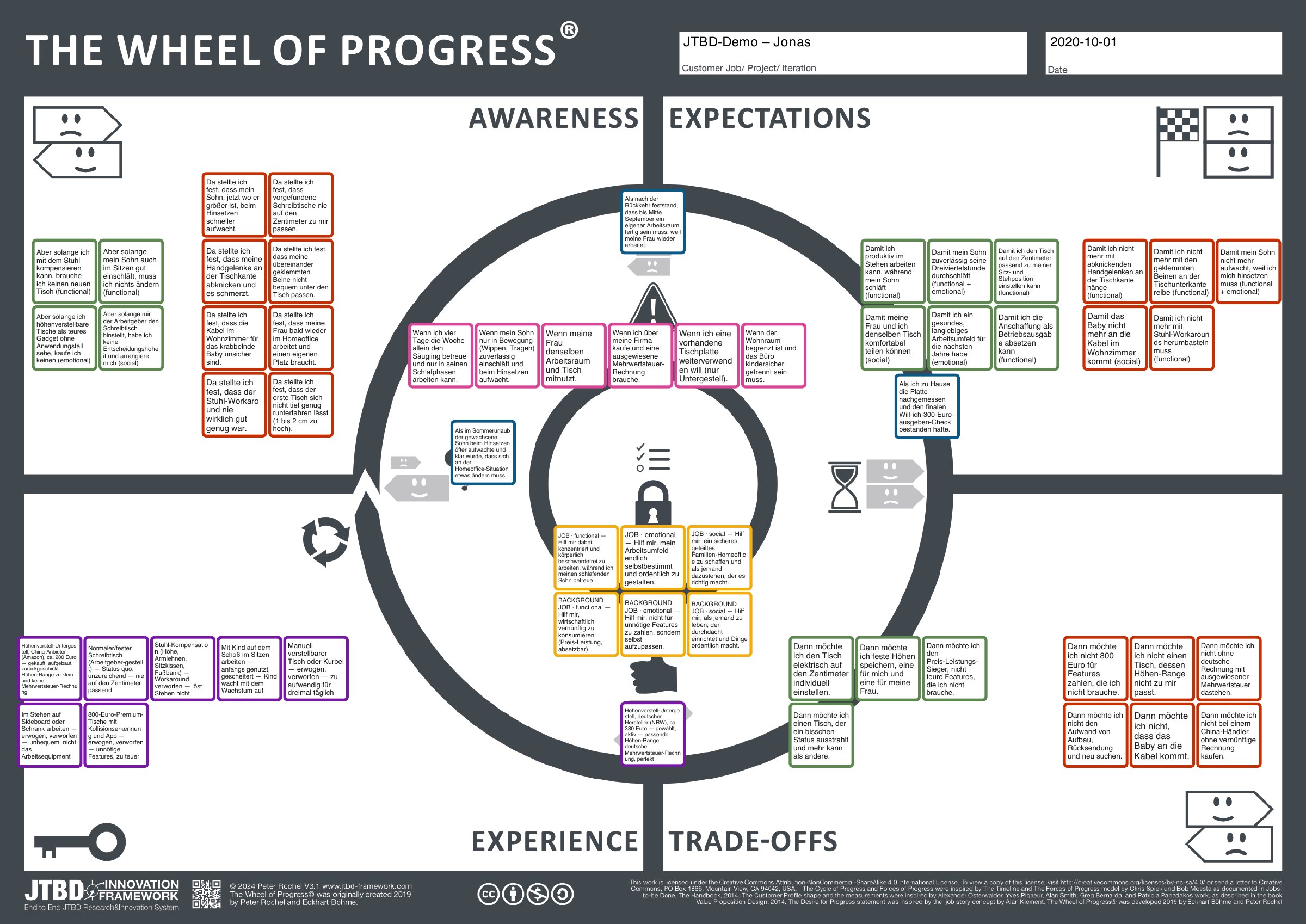
After that, you’ll find:
Included:
Not included:
We analyse your own interviews separately from the Finding, two working days after we have everything. And on top of that comes our verdict on how well they were conducted: what to keep next time and what to change.
Tell us beforehand what you have: hallo@oberwasser-consulting.de
Promised: we’ll be in touch within two working days of your booking.
One interview, conducted by us, with a person who fits the profile we define with you. If they don’t fit, even though we were the ones who searched for them, we conduct a second interview at no extra cost. Analysis and documentation against your list, two working days after the interview. And the results call with you.
Not promised: a fixed date for the interview, because it depends on how quickly the right person is found.
If we search and nobody is found within 30 days of the alignment call, you get a Positioning Assessment or your money back. If you search yourself and nobody has agreed within 30 days, you get a Positioning Assessment.
But we don’t promise that the interview will disprove your assumptions.
Perhaps it confirms them. Then you know that they hold, and what that rests on: a specific moment in the conversation, not a gut feeling.
Not promised: a statement about all your customers.
One interview is one case.
And not promised: any effect on your revenue, because you decide what you do with the Finding.
Do the maths: what does a development cycle, a campaign or a relaunch cost you if it rests on the wrong assumption? The Finding comes in just before that point.
€1,900 net, fixed price · €0 extra if you commission the sprint within 30 days · a second interview at no extra cost if the person doesn’t fit the agreed profile and we searched for them.
| If … | you pay for the Finding |
|---|---|
| you commission the sprint within 30 days of the results call | €0 extra. The €1,900 is credited in full. |
| no suitable person is found within 30 days of the alignment call, even though we are searching | €0 for the Finding. You get a Positioning Assessment or your money back. |
| you search yourself and nobody agrees within 30 days | €0 for the Finding. You get a Positioning Assessment. |
| the person doesn’t fit the profile we defined with you, and we searched for them | €1,900 net, once. The second interview costs you nothing. |
| you take the Finding and leave it at that | €1,900 net. The Finding is yours. |
In short: the €1,900 only stays on the bill if you take your Finding and go no further. Then you know what you previously only believed.
€1,900 net (plus VAT where applicable) · for customers in Germany: €2,261.00 including 19% VAT · payment on booking · you choose the date for the alignment call in the same step.
This offer is for businesses only.
Prefer to pay by invoice? Write to us at hallo@oberwasser-consulting.de.
One case shows you a direction. Sometimes one nobody saw coming. But it doesn’t show whether others buy the same way, from you or elsewhere. And we tell you so ourselves, before you notice it.
That’s why the results call ends with exactly this question: Is it the same for the others? The sprint answers it, with a handful of conversations with exactly the right people, analysed all the way to a decision. The interview from your Finding feeds into it. So you don’t pay twice if you go further within 30 days.
We agree in the alignment call who approaches the interviewee.
If you approach them, you only invite people you’re allowed to contact. If we find them in your market, they give their consent directly to us, and we don’t need your customer list for that. The conversation and everything after it stays with us.
Someone who recently bought and used your product for the first time, or something that, from the customer’s point of view, is an alternative to it, even from a completely different product category. As a rule, it isn’t a long-standing customer. There are exceptions, if they close a specific gap in your knowledge. The first purchase in particular shows what makes someone act in the first place. If the person bought elsewhere, they show you why they didn’t choose you. And anyone who has since switched or given up again shows you where things got stuck. In the alignment call, we decide with you which profile will be most revealing.
For consumers and for business customers who are easy to reach, we handle the search. It’s included in the price. It’s different with decision-makers whom hardly anyone can get on the phone: managing directors, board members, decision-makers in large corporations. There, the contact comes from your customer base, because someone like that is more likely to say yes to you than to us. Or we make you a separate offer for the search. We agree which option fits in the alignment call, before anyone is approached.
Only if you want them to. If you don’t want to be named or recognisable, you stay anonymous. We’ve done that many times. If the invitation comes from you, for example to someone from your customer base, the person naturally knows who it’s from.
As soon as the right person has been found and has agreed. We don’t promise you a date in advance, because it isn’t in our hands. What we do promise: analysis and documentation are ready two working days after the interview.
If we search and nobody is found within 30 days of the alignment call, we convert the order into a Positioning Assessment or refund the amount. Which of the two is up to you. If you search yourself and nobody has agreed within 30 days, we convert the order into a Positioning Assessment.
Then you know that your assumption holds, backed by a specific moment in the conversation. That’s exactly what the Finding is for: knowing before you commit budget. You keep the Finding, which is why there’s no money back for it. What we promise is the person. If they don’t fit the profile we defined with you, and we searched for them, we conduct a second interview at no extra cost.
No, because there isn’t one. We reconstruct a decision; we don’t work through a list. The next question follows from the last answer, along your interviewee’s story. Pre-written questions would carry your assumptions into the conversation, and those are exactly what we want to test. What you see beforehand and agree with us: the phases of the conversation, the topics that will definitely come up, and everything that must not come up.
Through your assumption list. It is our checklist: in the Finding, every assumption gets a verdict, holds, doesn’t hold or open. We just don’t ask about them directly, because a question like “Was the advice important to you?” already puts the answer in their mouth.
With your interviewee’s consent, you can listen in silently, and you get the transcript. You don’t see the questions beforehand, but afterwards you see every single one. Every statement in the Finding is tied to the exact point in the conversation it comes from.
Then you get the conversation outline with phases, topics, no-go areas, consent and how the data is handled. Not a list of questions, because that would devalue the Finding.
You can. If you already know you need the pattern, the sprint is the direct route. The Finding is for the moment before that: when you want to see in one case whether your assumptions hold and how we work, before you commit €16,500 or more. And if you go further within 30 days of the results call, you haven’t paid for anything twice. A short calculation shows whether the sprint then pays off for you (in German).
The Positioning Assessment measures from the outside whether answer engines name you when your market asks. The Buying-Reason Finding asks about the purchase itself: why someone buys your product, or an alternative to it, for the first time. Same price, different question. So you choose by the question that is costing you more right now.
Yes, silently, if your interviewee agrees. It’s a separate item in the consent form.
You can. And anyone who talks to customers themselves learns a lot; we’d never advise against it. If you want to master it, our training is the better route. The Finding is for when a decision is coming up and you don’t want to burn a contact: one conversation, led by someone who has nothing to sell the person, and checked against a list that was fixed beforehand.
€1,900
net (plus VAT where applicable) · for customers in Germany: €2,261.00 including 19% VAT · payment on booking · analysis and documentation two working days after the interview.
Prefer to pay by invoice? Write to us at hallo@oberwasser-consulting.de.
Then start with The OC Radar (in German) – a short email every two weeks, unsubscribe with one click.